Corporate gift programs in the automotive aftermarket increasingly turn to branded car refrigerator OEM solutions to create lasting impressions. A compressor car fridge with a custom logo and bespoke packaging transforms a functional utility item into a powerful brand touchpoint that recipients use daily on road trips, commutes, and outdoor adventures. This guide explores how Innovcool’s OEM capabilities across the K, Q, W, and X Series enable corporate buyers to launch high-impact branded gift campaigns with measurable and lasting brand recall.
TL;DR: A branded car refrigerator OEM program lets corporate buyers stamp their logo on a high-utility compressor fridge, wrap it in custom packaging, and distribute it through corporate gift programs. Innovcool ‘s four product series (K, Q, W, X) offer capacities from 18 to 50 liters, GMCC compressor reliability, and 5-to-7-day sample turnaround. Custom logo placement on the lid, body, and packaging — combined with 30-40 day mass production — makes car fridges one of the most effective branded gifts in the automotive aftermarket. Contact Innovcool to start your OEM project.
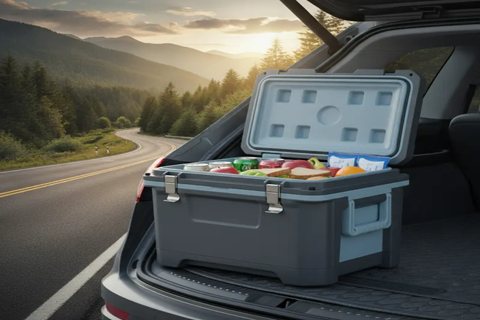
The automotive aftermarket has evolved far beyond replacement parts and accessories. Today, corporate gift programs in this sector aim to forge emotional connections between brands and their audiences. Whether the recipient is an auto dealership principal, a fleet manager, a motorsport sponsor, or a loyal aftermarket parts customer, the gift must deliver genuine utility. A branded car refrigerator OEM product checks every box: it is portable, technologically impressive, and used repeatedly in contexts that naturally reinforce brand visibility.
Traditional corporate gifts — pens, keychains, USB drives — tend to end up forgotten in drawers. Research published by the Advertising Specialty Institute consistently shows that high-utility promotional items generate significantly more impressions over their lifetime than low-cost novelty items. A compressor car fridge sits in the recipient’s vehicle, travels to campsites, tailgate parties, and family road trips, and is seen by passengers, fellow campers, and bystanders. Each usage cycle becomes an organic brand impression.
For automotive aftermarket brands, the alignment is even stronger. The product itself belongs in the vehicle ecosystem. A branded car refrigerator given away during a new vehicle launch, a dealership anniversary, or an aftermarket product expo immediately signals that the giving brand understands the recipient’s lifestyle. This congruence between product and context is what separates forgettable swag from memorable corporate gifts.
Not all car refrigerators are created equal, and corporate buyers evaluating OEM partners must understand the technical landscape. The market broadly splits into thermoelectric coolers and compressor-based units. Thermoelectric models are cheaper but can only cool to about 15-20 degrees below ambient temperature, making them unreliable in warm climates. Compressor car refrigerators, by contrast, use the same cooling technology found in household refrigerators, achieving temperatures as low as -22 degrees Celsius regardless of ambient conditions.
Innovcool, the brand identity of Zhejiang Innovcool Electric Technology Co., Ltd., has operated in this space since 2017 with a production facility spanning over 60,000 square meters. The company exports to more than 100 countries, producing over 2,000,000 units annually. This scale matters for corporate gift programs because it ensures consistent quality across large orders and the capacity to handle peak-season demand spikes, which are common during holiday gift campaigns and year-end corporate appreciation events.
The OEM process for branded car refrigerators involves several layers of customization. At the base level, a corporate buyer can request a custom logo on the product body and a branded retail box. At deeper levels of customization, buyers can specify color schemes, LCD panel overlays, custom accessories, instruction booklet branding, and even bespoke foam inserts shaped to cradle the unit within its branded packaging. Innovcool’s OEM vehicle cool box manufacturing capabilities cover the full spectrum from simple logo stamping to comprehensive brand immersion.
Another critical factor is the GMCC compressor used across Innovcool’s product range. GMCC, a subsidiary of Midea Group, is one of the world’s largest compressor manufacturers. Using a recognized compressor brand gives corporate buyers confidence that the branded gift will perform reliably for years, because nothing undermines brand recall faster than a gift that breaks down after the first use.
Logo placement strategy on a car refrigerator differs from flat-surface items like tote bags or T-shirts. A car fridge is a three-dimensional object viewed from multiple angles — from above when the lid is opened, from the side when it sits in a trunk or on a back seat, and from the front when the LCD panel is consulted for temperature settings. Effective brand recall therefore requires multi-point logo placement.
The primary logo position is the lid top. When the recipient opens the fridge to retrieve a cold beverage, the brand logo is the last visual cue before the hand reaches inside. This high-frequency, high-visibility placement generates the strongest recall. Innovcool supports silk-screen printing, UV printing, and embossed logo techniques on the lid surface, allowing corporate buyers to match their brand guidelines precisely.
Secondary placements include the side panels and the front LCD bezel. Side-panel logos are visible when the fridge sits in a vehicle trunk, on an RV countertop, or on a campsite table. The front-panel logo appears near the digital temperature display, creating a subtle but persistent association between the brand and the product’s technical sophistication. For corporate gift programs targeting automotive aftermarket professionals, this technical association is especially valuable — it positions the gifting brand as innovative and forward-thinking.
Tertiary placements extend to accessories. The DC power cable, the carrying handle, and even the drain plug can be subtly branded. While these placements are small, they reinforce the brand identity during every interaction the recipient has with the product. Over months and years of use, these micro-impressions accumulate into strong brand recall, which is the ultimate goal of any corporate gift program.
The psychology behind this approach is well-documented. According to research from the Promotional Products Association International, recipients of branded functional items can recall the advertiser’s name at rates exceeding 80 percent, compared to less than 20 percent for most digital ad formats. A car refrigerator, as a high-utility, high-visibility item, sits at the top of this effectiveness curve.
In corporate gift programs, packaging is not an afterthought — it is a strategic asset. The unboxing experience sets the emotional tone for the entire brand relationship. A branded car refrigerator delivered in generic brown cardboard sends a message of cost-cutting. The same unit presented in a sleek, full-color retail box with a custom sleeve, branded tissue paper, and a personalized thank-you card sends an entirely different message: this brand values quality, attention to detail, and the recipient’s experience.
Innovcool’s OEM packaging service covers every layer. The outer retail box can be printed with corporate colors, logos, taglines, and campaign-specific messaging. Inner foam inserts are CNC-cut to fit each model precisely, protecting the product during transit while creating a premium reveal moment when the lid is lifted. Accessory pouches for the DC cable, AC adapter, and user manual can be branded to match the overall packaging design.
For corporate gift programs targeting the automotive aftermarket, packaging design often incorporates vehicle-related motifs — tire tread patterns, dashboard textures, or racing stripe accents — that resonate with the recipient’s professional identity. Innovcool’s design team works with corporate buyers to translate brand guidelines into packaging art that is both visually striking and production-ready within the 30-to-40-day mass production timeline.
Packaging also serves a practical function in the gift distribution chain. Corporate gifts often travel from the manufacturer’s warehouse to the buyer’s distribution center, then onward to individual recipients via courier. Robust packaging with adequate cushioning ensures the branded car refrigerator arrives in showroom condition, regardless of how many handling stages it passes through. Innovcool’s packaging engineers conduct drop tests and vibration tests to validate transit durability, a detail that discerning corporate buyers appreciate.
Choosing the right product series is essential for aligning the gift with the target audience, budget, and campaign objectives. Innovcool offers four distinct series, each tailored to different use cases within the corporate gift landscape.
The K Series occupies the sweet spot for broad-audience corporate gift programs. With capacities ranging from 19 to 30 liters, these units are compact enough to fit in any vehicle’s trunk or back seat, yet large enough to hold a meaningful quantity of beverages or snacks. The K Series is ideal for mass-distribution campaigns such as dealership customer appreciation gifts, auto show attendee giveaways, and fleet driver rewards. Its mid-range capacity also makes it suitable for food delivery professionals who need reliable cooling for short-to-medium routes.
The Q Series targets recipients who demand ruggedness and performance. With capacities from 26 to 32 liters and reinforced construction, the Q Series is designed for overland expedition enthusiasts, off-road vehicle owners, and adventure motorsport participants. Corporate gift programs targeting this audience — such as off-road accessory brands, tire manufacturers, and overland tour operators — benefit from the Q Series’ association with durability and capability. The rugged aesthetic also photographs well for social media unboxing content, extending the brand reach beyond the individual recipient.
The W Series introduces dual-zone cooling, allowing recipients to refrigerate beverages in one compartment while freezing ice cream or storing frozen meals in the other. This innovation elevates the perceived value of the gift significantly, making the W Series the preferred choice for VIP client gifts, executive appreciation programs, and high-value channel partner rewards. The dual-zone feature also generates conversation among the recipient’s peers, creating organic word-of-mouth brand exposure that compounds the return on the corporate gift investment.
The X Series is Innovcool’s flagship range for corporate gift programs targeting large-vehicle owners — RV enthusiasts, commercial fleet operators, and marine professionals. With capacities up to 50 liters in a dual-zone configuration, the X Series delivers substantial cooling power. Its larger footprint provides more surface area for logo placement, making it a walking billboard when used at campsites, marinas, and tailgate gatherings. Corporate buyers in the RV and marine aftermarket find the X Series particularly effective for dealer incentive programs and owner club membership gifts.
Explore the full product range at Innovcool’s car refrigerator catalog.
Understanding the OEM timeline is critical for corporate gift programs, which often revolve around fixed event dates, holiday seasons, or fiscal-year-end deadlines. Innovcool’s OEM process is structured to minimize lead times while maximizing customization flexibility.
Step 1: Consultation and Series Selection. The process begins with a consultation where the corporate buyer’s target audience, budget range, and campaign objectives are discussed. Innovcool’s export team recommends the most suitable series — K, Q, W, or X — based on these parameters. This stage typically takes 1 to 2 business days.
Step 2: Artwork and Customization Specification. The buyer submits logo files, color references, and packaging design briefs. Innovcool’s design team produces digital mockups showing logo placement on the product body, lid, and packaging. Revision rounds are included until the buyer approves the final design. This stage usually takes 3 to 5 business days.
Step 3: Sample Production. Once artwork is approved, Innovcool produces a physical sample incorporating all customizations — custom logo printing, branded packaging, and any specified color modifications. Sample production takes 5 to 7 working days. The sample is shipped via express courier for the buyer’s evaluation.
Step 4: Mass Production. After sample approval, mass production begins. Innovcool’s 60,000+ square meter facility and annual capacity exceeding 2,000,000 units ensure scalability. Mass production for a typical corporate gift order takes 30 to 40 days, depending on quantity and complexity.
Step 5: Quality Inspection and Shipping. Every unit undergoes quality inspection aligned with ISO 9001 standards. Innovcool also supports third-party inspection by agencies such as SGS or Bureau Veritas, should the corporate buyer require it. Shipping arrangements — FOB, CIF, or DDP — are coordinated per the buyer’s preference.
This end-to-end process, from initial inquiry to delivered goods, typically spans 6 to 10 weeks. Corporate gift program planners should initiate the OEM process at least 3 months before the target distribution date to accommodate potential revisions and logistics variables.
For AC/DC dual-power configurations that expand the gift’s usability beyond vehicles, Innovcool’s AC/DC car fridge OEM capabilities provide models compatible with both 12V/24V vehicle sockets and standard household AC power via an optional adapter.
The versatility of branded car refrigerators as corporate gifts spans multiple industries within and adjacent to the automotive aftermarket. Understanding these applications helps corporate buyers identify the highest-impact gift strategy for their specific audience.
Dealership Networks. Automotive dealerships use branded car fridges as customer delivery gifts — given to new vehicle buyers at the point of sale. The fridge, emblazoned with the dealership’s logo, travels in the customer’s new vehicle, reinforcing the purchase decision and strengthening dealer-customer loyalty. Some dealerships also use branded fridges as prizes for test-drive events and seasonal sales campaigns.
Aftermarket Parts and Accessories Brands. Companies that manufacture or distribute aftermarket parts — from performance exhaust systems to off-road lighting kits — use branded car fridges as trade show booth gifts, influencer outreach packages, and loyal-customer rewards. The fridge’s association with vehicle utility aligns perfectly with the brand’s core value proposition.
Fleet and Logistics Companies. Fleet operators gift branded car refrigerators to drivers as performance incentives or milestone rewards. A driver who receives a quality car fridge from the company feels valued, and the branded unit in the truck cabin serves as a constant reminder of the employer’s investment in driver welfare.
Insurance and Financial Services. Auto insurance companies and vehicle financing firms use high-value branded gifts to retain policyholders and borrowers. A branded car refrigerator given at policy renewal or loan completion creates a tangible, positive association with the financial brand, which is otherwise abstract and intangible in the recipient’s mind.
Overland and Outdoor Recreation Brands. Companies in the overland, camping, and outdoor recreation space find that branded car fridges are natural extensions of their product ecosystem. Gifting a branded fridge to top-tier customers, brand ambassadors, and event sponsors generates authentic social media content and strengthens community bonds.
Corporate Employee Rewards. Beyond external audiences, branded car refrigerators serve as internal corporate gifts for employee recognition programs. Years-of-service awards, sales achievement incentives, and holiday gifts gain perceived value when the item is both functional and premium. The employee’s family uses the fridge on outings, extending the brand’s internal goodwill into the employee’s personal network.
Corporate buyers unfamiliar with car refrigerator technology should understand several key specifications that affect both the gift’s perceived value and its long-term brand recall performance.
Compressor Quality. The compressor is the heart of any car refrigerator. Innovcool uses GMCC compressors, which are recognized globally for efficiency and durability. A branded gift that fails mechanically within months does more harm to brand perception than no gift at all. Compressor quality is non-negotiable.
Temperature Range. Innovcool’s full range operates from +20 degrees Celsius down to -22 degrees Celsius. This range covers everything from gentle cooling of beverages to deep freezing of perishable food. For corporate gift recipients, the ability to freeze items is a differentiator — it elevates the fridge from a “nice cooler” to a “serious appliance.”
Power Compatibility. All Innovcool models operate on DC 12V and 24V, covering passenger cars, trucks, and commercial vehicles. An optional AC adapter extends usability to hotel rooms, offices, and homes. This dual-power flexibility increases the number of usage contexts, which directly correlates to the number of brand impressions generated.
Energy Efficiency Modes. ECO mode reduces power consumption for extended cooling during long drives or overnight camping. High Speed mode rapidly cools contents when the fridge is first loaded. These modes demonstrate technical sophistication that impresses recipients and enhances the perceived value of the branded gift.
Noise Level. At below 45 decibels, Innovcool’s car refrigerators operate quieter than most vehicle air conditioning systems. Low noise is especially important for RV and marine applications where the fridge runs continuously in enclosed living spaces. A quiet fridge means the recipient associates the brand with quality engineering rather than annoying background noise.
Low Voltage Protection. Three levels of low-voltage protection prevent the fridge from draining the vehicle’s battery. This feature protects the recipient’s vehicle — a critical consideration for corporate gift programs, since a gift that damages the recipient’s car battery would create a deeply negative brand association.
Tilt Tolerance. Innovcool’s car refrigerators tolerate up to 30 degrees of tilt, ensuring stable operation on uneven terrain. For overland expedition and off-road gift recipients, this specification is essential and communicates that the brand understands real-world usage conditions.
The table below summarizes key specifications across Innovcool’s four series:
| Series | Capacity | Temp Range | Power | Key Feature | Ideal Gift Scenario |
| K Series | 19-30L | +20 to -22 C | DC 12V/24V | Compact versatility | Mass corporate giveaways |
| Q Series | 26-32L | +20 to -22 C | DC 12V/24V | Rugged build | Off-road / overland gifts |
| W Series | 18-25L + 35L dual | +20 to -22 C | DC 12V/24V | Dual-zone cooling | VIP / executive gifts |
| X Series | 25-50L dual | +20 to -22 C | DC 12V/24V | Maximum capacity | RV / marine gifts |
Distributing a branded car refrigerator is only the beginning. To maximize brand recall, corporate gift programs should incorporate strategic layers around the physical gift.
Personalization Beyond the Logo. Adding the recipient’s name or a personalized message to the packaging or an included card transforms the gift from a generic promotional item into a personal gesture. Personalization dramatically increases the likelihood that the recipient will keep and use the product, rather than re-gifting or storing it away.
Unboxing Content Integration. Including a QR code inside the packaging that links to a video message from the brand’s CEO, a setup tutorial, or an exclusive offer creates a digital bridge from the physical gift to the brand’s online ecosystem. This integration tracks engagement and extends the brand interaction beyond the initial unboxing moment.
Social Media Amplification. Encouraging recipients to share photos of their branded fridge in action — at campsites, on road trips, at tailgate parties — with a branded hashtag generates organic social proof. Corporate gift programs that include a small incentive for social sharing (a secondary gift card, a loyalty points bonus) see significantly higher participation rates.
Seasonal Campaign Alignment. Timing the gift distribution to coincide with summer road trip season, holiday travel, or major automotive events (auto shows, racing seasons) maximizes immediate usage. A branded car refrigerator received in May will be used extensively over the following summer months, generating months of continuous brand impressions.
Follow-Up Engagement. Sending a follow-up email or message 30 days after gift delivery, asking how the recipient is enjoying their car fridge and offering accessories or complementary products, extends the brand relationship and opens cross-selling opportunities.
The Promotional Products Association International (PPAI) reports that functional promotional products like car refrigerators generate an average of 3,400 impressions over their lifetime, far exceeding the impression count of most advertising channels at comparable cost. For corporate gift programs in the automotive aftermarket, this figure is even higher due to the product’s natural alignment with the recipient’s interests and lifestyle.
The success of a branded car refrigerator corporate gift program depends heavily on the OEM partner’s capabilities, reliability, and service quality. Corporate buyers should evaluate potential partners against several critical criteria.
Production Scale and Capacity. A partner with a large production facility can handle volume surges and maintain consistent quality across large orders. Innovcool’s 60,000+ square meter factory and 2,000,000+ annual unit capacity provide the scale needed for enterprise-level corporate gift programs.
Quality Certifications. ISO 9001 (quality management), ISO 14001 (environmental management), and BSCI (social compliance) certifications demonstrate a commitment to international standards. Many corporate buyers, especially multinational corporations, require these certifications as a prerequisite for vendor approval.
OEM Experience. Innovcool has accumulated over 9 years of OEM and ODM experience, serving clients in more than 100 countries. This experience translates into efficient communication, accurate artwork execution, and proactive problem-solving during the production process.
Sample Speed. A 5-to-7-day sample turnaround is industry-leading for car refrigerator OEM. Fast samples allow corporate gift planners to evaluate the physical product early in the campaign planning process, reducing the risk of late-stage surprises.
Flexibility. Every corporate gift program is unique. The ideal OEM partner offers flexible MOQ, multiple logo printing methods, and willingness to accommodate special packaging requests. Rigid, one-size-fits-all OEM terms limit the creative possibilities that make branded car refrigerator gifts stand out.
Communication and Support. Responsive communication across time zones is essential for international corporate gift programs. Innovcool’s export team maintains communication via email, messaging platforms, and video calls, ensuring that corporate buyers receive timely updates throughout the production process.
Connect with Innovcool on Facebook to see the latest product launches and OEM project showcases.
Summary: Branded car refrigerator OEM programs combine custom logo, premium packaging, and high-utility design to deliver unmatched brand recall for corporate gift campaigns in the automotive aftermarket.
Yubin Wu
Executive Director, Zhejiang Innovcool Electric Technology Co., Ltd. (Innovcool)
Specializing in K/Q/W/X Series compressor car refrigerators. Oversees export operations across expedition vehicles, RV, food delivery, marine, and corporate gifting channels.
Innovcool maintains a flexible MOQ policy. Depending on the series and customization depth, corporate buyers can begin with trial quantities that suit pilot gift programs. This flexibility allows brands to test the branded car refrigerator as a corporate gift before committing to large-volume orders. Contact the sales team at edward@1stcoolchina.com or through the Innovcool contact page for a tailored quotation.
Sample production typically requires 5 to 7 working days after artwork approval. Express courier delivery adds 3 to 5 days depending on destination country. Corporate gift planners should factor in this timeline when scheduling their campaign milestones. Rush sample options may be available for time-sensitive projects.
Yes. Innovcool offers full packaging customization including retail box design, sleeve printing, inner foam inserts, instruction booklet branding, and accessory pouches with corporate identity. Every touchpoint of the unboxing experience can be tailored to reflect the gifting brand’s visual identity and campaign messaging.
Innovcool holds ISO 9001 quality management, ISO 14001 environmental management, and BSCI social compliance certifications. These certifications ensure that branded car refrigerator products meet international corporate procurement standards and satisfy the due diligence requirements of multinational corporate gift programs.
All Innovcool compressor car refrigerators operate from +20 degrees Celsius down to -22 degrees Celsius. This full-range capability supports both gentle refrigeration for beverages and deep-freeze for perishable items, making the branded gift versatile enough to impress recipients with diverse cooling needs.
Absolutely. Car refrigerators serve as high-perceived-value gifts for employee milestone rewards, client appreciation programs, trade show giveaways, VIP loyalty schemes, and automotive aftermarket promotional campaigns. Their combination of practical utility, premium feel, and prominent logo placement makes them one of the most effective corporate gift categories available today.
Yacht suppliers face a logistics challenge that land-based cold chain operators rarely encounter. When a vessel leaves the dock carrying premium seafood bound for high-end restaurants or direct-to-consumer delivery, the refrigeration system must perform flawlessly under constant vibration, rolling seas, limited power budgets, and salt air corrosion. A compressor car refrigerator designed for sedan trunk use will fail within weeks in this environment. The Innovcool X Series smart car refrigerator was engineered specifically to address these conditions, combining rapid dual-zone cooling with marine-grade durability in a portable format that yacht suppliers can deploy without permanent installation.
The stakes are high in premium seafood logistics. Tuna, salmon, langoustine, and live-shellfish cargo require precise temperature control with zero tolerance for excursions. A 30-minute delay in reaching target temperature can shorten shelf life by a full day. Dual-zone capability allows suppliers to maintain fresh fish at 0-2 degrees C in one compartment while storing frozen product at -18 degrees C in the other, all within a single portable unit that draws less than 55 watts from the yacht electrical system.
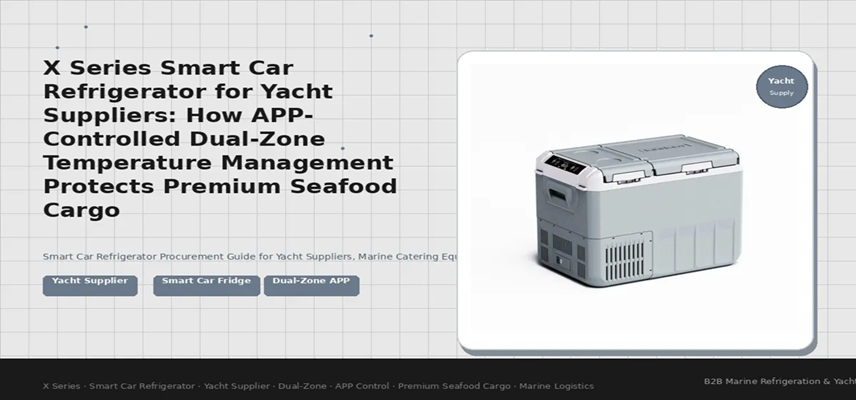
Innovcool X Series dual-zone compressor car refrigerator with LCD panel and independent temperature controls for each compartment
The marine environment creates unique demands that standard car refrigerators cannot meet. Salt spray accelerates corrosion on exposed metal components. Continuous wave action subjects the unit to multi-axis vibration and tilt angles that can reach 25-30 degrees in moderate seas. Power budgets on yachts are carefully managed, especially on sailing vessels where engine run-time for charging is limited. And the premium seafood cargo itself demands tighter temperature tolerances than typical grocery transport.
A standard automotive refrigerator assumes a relatively stable horizontal position, vibration limited to road surface irregularities, and abundant electrical power from the vehicle alternator. None of these assumptions hold on a yacht. The dual-zone camping compressor car fridge from Innovcool addresses each of these gaps through specific engineering choices. The compressor mounting system absorbs multi-directional vibration. The sealed exterior resists salt air ingress. The three-level battery protection system monitors voltage continuously and disconnects at user-selected thresholds to prevent draining the yacht starting battery below safe levels.
For yacht suppliers handling charter provisioning, commercial fishing fleet support, or luxury resort delivery, the portable format matters as much as the cooling performance. Permanent marine refrigeration installations require structural modification, certified electrical work, and significant capital investment. A portable compressor unit can be loaded onto the yacht deck, plugged into a standard 12V or 24V outlet, and put into service immediately. When the voyage ends, the same unit moves to the next vessel or returns to the warehouse. This flexibility is particularly valuable for charter companies that operate multiple vessels with varying refrigeration needs.
The defining feature of the Innovcool X Series is its dual-zone cooling architecture. Two separate compartments within a single housing each receive independent temperature control through the LCD panel or mobile APP. This means a yacht supplier can set one zone to 0 degrees C for fresh fish fillets and the other to -18 degrees C for frozen shellfish, with each zone maintaining its target temperature without interference from the other.
The practical value becomes clear when considering a typical charter provisioning run. A yacht departing for a three-day cruise might carry fresh sea bass, live lobster, frozen tuna steaks, and ice cream for dessert service. Each product category has a different optimal storage temperature. Fresh fish performs best at -1 to 2 degrees C. Live shellfish needs 2-4 degrees C with humidity control. Frozen items require -18 degrees C or below. Ice cream demands -20 degrees C. Without dual zones, the supplier faces an impossible compromise: store everything at one temperature and accept quality degradation for some products, or load two separate refrigeration units and double the power consumption and deck space requirements.
The expedition dual-zone compressor car fridge resolves this with fully independent temperature controls per zone. The compressor intelligently distributes cooling capacity between zones based on demand, prioritizing whichever zone is furthest from its target. Removable baskets allow flexible interior configuration, and dual reversible doors enable access from either side of the unit regardless of how it is secured on deck.
Speed of cooldown directly impacts seafood quality and food safety. The longer perishable cargo remains in the temperature danger zone between 4 degrees C and 60 degrees C, the faster bacterial populations multiply. For premium seafood destined for raw consumption, such as sashimi-grade tuna or oysters, any temperature excursion can render the product unsuitable for its intended use.
The Innovcool X Series achieves cooling from 20 degrees C to 0 degrees C in just 15 minutes, powered by a high-efficiency compressor operating at a maximum of 55 watts. This rapid pull-down means that seafood loaded at ambient temperature reaches safe storage temperature before bacterial growth becomes a concern. The W Series, designed for larger group expeditions, offers similar performance with a 25-minute cooldown from 20 degrees C to 0 degrees C and capacities ranging from 35 liters to 55 liters.
For yacht suppliers, the practical implication is straightforward. Load the refrigerated cargo, set the target temperatures on the LCD panel or through the mobile APP, and within 15 minutes both zones are at their targets. There is no pre-cooling period required, no need to run the unit empty for an hour before loading. This is particularly valuable for last-minute charter provisioning where the supplier receives the order, loads the cargo, and delivers to the marina within a compressed timeline.
Power management is a critical consideration for any electrical equipment on a yacht. Marine diesel generators are expensive to run, battery banks have finite capacity, and solar panels produce variable output depending on weather and latitude. A refrigeration unit that draws excessive power forces the supplier to choose between running the generator continuously or risking a dead battery that could compromise the vessel starting system.
The Innovcool X Series addresses this with a maximum power consumption of 55 watts and average daily energy use below 1 kilowatt-hour. In ECO mode, the compressor cycles intelligently to maintain target temperature while minimizing energy draw. The unit operates on 12V or 24V DC systems, compatible with standard yacht electrical architectures, and includes DC/AC power cords for shore power connections when available.
The three-level adjustable battery protection system is particularly important for yacht applications. Users can set the low-voltage disconnect point at three thresholds, with the highest protection level activating at 12.4V and the lowest at 8.5V. This prevents the refrigerator from draining the yacht starting battery below the level needed to restart the engine. When the disconnect activates, the refrigerator shuts down gracefully and resumes operation automatically when voltage recovers. For extended voyages where the refrigerator runs continuously for days, this protection is not a convenience feature but a safety requirement.
Yacht refrigeration must perform under conditions that would disable a standard car refrigerator within hours. Wave action subjects equipment to continuous tilting, often exceeding 15-20 degrees in moderate seas and reaching 30 degrees or more in rough conditions. The compressor, which relies on oil circulation for lubrication, is particularly sensitive to tilt. At excessive angles, oil migrates away from the compressor bearings, causing accelerated wear and eventual failure.
The Innovcool X Series is engineered with a shock-resistant compressor mounting system that maintains reliable operation at tilt angles up to 30 degrees. Internal baffles prevent oil migration during tilting, and reinforced handles with anti-vibration dampeners secure the unit to the deck or mounting surface. The matte-black exterior finish resists salt spray and UV exposure, maintaining structural integrity through extended marine deployment.
The LCD control panel displays real-time temperature for both zones, compressor status, and battery voltage. Operators can monitor conditions without opening the lid, which is critical for maintaining temperature stability during long crossings. The mobile APP extends this monitoring capability, allowing the captain or crew to check refrigeration status from the bridge without returning to the storage area. This remote monitoring is especially valuable on larger yachts where the refrigerator may be stored in an aft lazarette or below-deck storage compartment.
The X Series offers three capacity options to match different yacht sizes and cargo requirements. The X-25A provides a compact 25.3-liter capacity in a 603x375x373mm footprint, weighing just 12.2 kilograms net. This model suits day-trip charter provisioning, tender resupply runs, or as a secondary unit for beverages and snacks separate from the main galley refrigerator.
The X-35 steps up to 35 liters at 603x375x457mm and 13.8 kilograms, offering enough capacity for a weekend charter provisioning run for 6-8 guests. The X-55 delivers the full 50-liter capacity at 603x375x508mm and 15.1 kilograms, suitable for extended voyages, commercial fishing fleet support, or luxury resort delivery where larger volumes of premium seafood must be maintained at precise temperatures.
All three models share the same dual-zone cooling architecture, compressor technology, LCD panel, mobile APP connectivity, and three-level battery protection. The choice between models comes down to cargo volume and available deck space. Yacht suppliers operating mixed fleets can standardize on the X Series platform while selecting different capacities for different vessel types, simplifying training and spare parts inventory.
| Model | Capacity | Dimensions (mm) | Net Weight (kg) |
| X-25A | 25.3L | 603 x 375 x 373 | 12.2 |
| X-35 | 35L | 603 x 375 x 457 | 13.8 |
| X-55 | 50L | 603 x 375 x 508 | 15.1 |
Modern yacht fleet operations require centralized monitoring and documentation. Charter companies, commercial fishing operators, and luxury resort supply chains all benefit from the ability to track refrigeration status across multiple units from a single interface. The Innovcool X Series mobile APP enables this through wireless connectivity that pairs each refrigerator with a smartphone or tablet.
Through the APP, operators can set target temperatures for each zone independently, monitor real-time temperature readings, receive alerts when temperatures deviate from setpoints, and review historical temperature logs for compliance documentation. For seafood suppliers subject to HACCP or cold chain documentation requirements, this digital record-keeping eliminates manual temperature log sheets and provides auditable data for regulatory inspections.
The APP also supports multi-unit management, allowing a fleet manager to monitor refrigeration status across several vessels or delivery vehicles simultaneously. When a temperature alarm triggers, the manager receives an immediate notification and can instruct the crew to take corrective action before cargo quality is affected. This proactive monitoring capability transforms the refrigerator from a passive cooling device into an active component of the cold chain management system.
The Innovcool X Series compressor car refrigerator cools from 20 degrees C to 0 degrees C in just 15 minutes and reaches a minimum temperature of -18 degrees C. This rapid cooling capability is critical for yacht suppliers handling temperature-sensitive seafood, as it minimizes the time perishable cargo spends in the bacterial growth zone between 4 degrees C and 60 degrees C.
Dual-zone cooling provides two independently controlled compartments within a single unit, allowing yacht operators to maintain different temperature settings simultaneously. One zone can hold fresh fish at 0-2 degrees C while the other stores frozen items at -18 degrees C. This eliminates the need for separate refrigeration units, saving valuable deck space while ensuring each product category stays at its optimal storage temperature without cross-contamination of flavors.
The Innovcool X Series operates on 12V/24V DC power systems, compatible with standard yacht electrical systems. Maximum power consumption is 55W, drawing less than 1 kWh per day. A three-level adjustable battery protection system prevents complete battery drain by monitoring voltage and cutting off power at user-selected thresholds between 8.5V and 12.4V. This protects the yacht starting battery while ensuring continuous refrigeration during extended voyages.
Yes. The Innovcool X Series features shock-resistant construction that maintains reliable operation at tilt angles up to 30 degrees. This is essential for yacht applications where wave action constantly shifts the vessel angle. The compressor and internal components are engineered to handle continuous vibration and tilting without performance degradation, ensuring consistent cooling even in rough sea conditions.
The X Series offers three capacity options. The X-25A provides 25.3 liters in a compact 603x375x373mm footprint weighing 12.2 kg net. The X-35 offers 35 liters at 603x375x457mm and 13.8 kg. The X-55 delivers 50 liters at 603x375x508mm and 15.1 kg. All three models share the same dual-zone cooling system, LCD control panel, and 12V/24V DC compatibility. Yacht suppliers can select the capacity that matches their cargo volume and available deck space.
Zhejiang Innovcool Electric Technology (Innovcool) operates under ISO 9001 quality management and ISO 14001 environmental management certifications, along with BSCI social compliance certification. The factory spans 8,544 square meters with a new 54,000 square meter facility in Anhui Province. These certifications provide yacht suppliers and fleet operators with documented quality assurance for export markets worldwide.
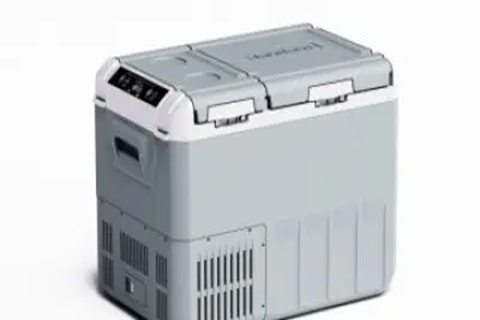
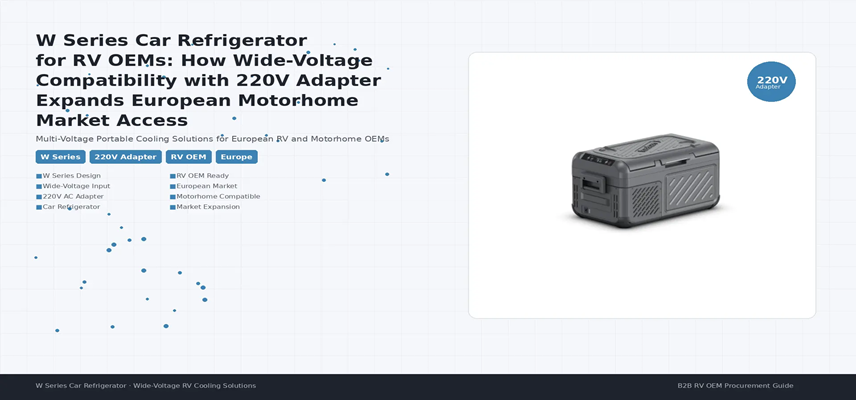
When European RV manufacturers evaluate compressor car refrigerators for OEM integration, the voltage question comes first. European motorhomes operate on a dual-voltage ecosystem — a system documented in the UNECE vehicle regulations framework: DC 12V or 24V from the vehicle battery while driving, and 220V AC from campground hookups or inverter systems while parked. A refrigerator that only handles one voltage forces the OEM to add external adapters or voltage converters — adding cost, complexity, and a potential failure point in the supply chain. The Innovcool W Series car refrigerator was designed specifically to solve this dual-voltage challenge.
I have worked with RV OEMs across Europe for years, and the specification that separates a viable OEM refrigerator from a rejected sample is not cooling performance — most compressor fridges can reach -22°C. It is the electrical compatibility. The W Series accepts DC 12V and DC 24V natively with automatic voltage detection, and an optional 220V AC adapter allows the same unit to run from European campground mains. This means the OEM specifies one refrigerator model for the entire European market, regardless of whether the motorhome is a compact campervan on a Fiat Ducato chassis (12V) or a large integrated motorhome on an Iveco Daily chassis (24V).
European motorhome electrical systems are not standardized to a single voltage. Compact campervans built on Fiat Ducato, Peugeot Boxer, or Citroen Jumper chassis use 12V DC systems. Larger integrated motorhomes on Mercedes Sprinter, Iveco Daily, or MAN TGE chassis often use 24V DC systems. Additionally, most European campsites provide 220V AC hookups, and many motorhome owners install inverters that convert battery DC to mains AC for appliances.
An OEM that must source separate 12V and 24V refrigerator SKUs for different chassis platforms faces doubled inventory complexity, separate quality validation for each SKU, and potential supply chain disruptions if one voltage variant is delayed. The W Series eliminates this complexity by accepting both DC 12V and DC 24V through a single auto-sensing input — the refrigerator detects the connected voltage and adjusts internally without operator intervention. The optional 220V AC adapter then covers the campground hookup scenario, meaning one SKU serves all three power sources.
This single-SKU advantage is particularly valuable for European OEMs operating under EU type-approval regulations (2018/858), where each vehicle variant requires separate documentation. Reducing the number of refrigerator variants simplifies the type-approval paperwork and reduces the OEM’s compliance burden.
The Innovcool W Series car refrigerator range covers the full spectrum of European motorhome sizes, from compact two-person campervans to family-size integrated motorhomes. The range includes four product lines, each optimized for different OEM integration scenarios.
The W-18 series is designed for compact campervans and van conversions where interior space is at a premium. At 616 x 340 x 338mm (18L model), it fits standard campervan kitchen units designed for the European market. The GMCC compressor cools from +20°C to -22°C, with ECO and MAX operating modes. Average power consumption is low enough to run from a 100Ah leisure battery for extended periods without solar recharge. The unit weighs 12.7 kg (net weight), making it manageable for single-person installation during the vehicle build process.
For larger motorhomes with dedicated kitchen or storage compartments, the W-40 series offers 40L, 50L, and 60L capacities. The DL wheeled variants (W-40DL through W-60DL) include detachable wheels and a telescopic pull handle, allowing the refrigerator to be removed from the vehicle for cleaning or used as a standalone cooler at the campsite. The standard dimensions of 670 x 406 x 440mm (40L) fit the DIN standard compartment sizes used by European motorhome furniture manufacturers.
The W-35 series is the flagship for RV OEM integration. Dual-zone design means the refrigerator maintains independent temperatures in each compartment — one zone for fresh food at +4°C and one for frozen items at -18°C, simultaneously. This eliminates the need for a separate freezer unit in space-constrained motorhome layouts. The compressor cools from 20°C to 0°C in approximately 25 minutes, with average power consumption of 50W. The 3-level battery protection system (low/medium/high thresholds at 8.5V, 11.4V, and 12.4V for 12V systems) prevents the refrigerator from draining the vehicle battery below the level needed to start the engine.
For OEMs, the W-35 series offers the best balance of capacity, functionality, and integration flexibility. The dual reversible doors allow the OEM to configure door opening direction to match the motorhome layout — critical for European motorhomes where kitchen configurations vary significantly between manufacturers.
The W-35S series takes the dual-zone concept further by providing two completely separate doors instead of a single reversible door. This allows independent access to each zone without opening the other — reducing cold air loss and improving energy efficiency. For motorhome OEMs targeting the premium segment, the separate-door design provides a more appliance-like appearance that aligns with the expectations of European motorhome buyers.
The optional 220V AC adapter is the component that completes the European motorhome power ecosystem. When the motorhome is parked at a campsite with electrical hookup, the refrigerator switches from battery DC power to mains AC power through the adapter. This is not just a convenience feature — it is an operational requirement for European RV use, where motorhomes may be parked at a campsite for weeks and relying solely on battery power is not practical.
The adapter is designed as a separate accessory rather than an integrated component because European motorhome OEMs prefer to offer it as an optional upgrade. This keeps the base refrigerator cost competitive while allowing the OEM to bundle the adapter with premium motorhome packages. The adapter connects to the refrigerator’s DC input socket and converts 220V AC to the appropriate DC voltage internally.
OEM Integration Note: When specifying the W Series for a motorhome model, confirm the chassis electrical system voltage (12V or 24V) and the expected campground hookup standard (230V AC in most of Europe, 220V AC in some regions). The W Series handles voltage variation automatically, but the OEM’s wiring harness must be specified correctly during vehicle design.
The single most common service complaint from motorhome owners — after water system issues — is a flat vehicle battery caused by a refrigerator that ran too long while the vehicle was parked. The W Series addresses this with a 3-level low voltage battery protection system that monitors the input voltage and disconnects the compressor before the battery drops below a safe starting threshold.
The three protection levels are:
For 24V systems, the thresholds are proportionally higher. The protection system is adjustable by the user through the LCD control panel, which also displays the current voltage reading — allowing the motorhome owner to monitor battery health in real time.
European motorhome owners frequently sleep in the same compartment as the refrigerator — unlike commercial vehicle applications where the driver is separated from the cargo area. This makes noise level a critical specification for RV OEM integration, and the W Series is engineered to operate below 45 dB across all models.
The GMCC compressor used in the W Series is designed for low-vibration operation with rubber isolation mounts that decouple the compressor from the refrigerator chassis. The result is a hum that is comparable to a quiet library — noticeable if you listen for it, but not disruptive to sleep. The ECO mode further reduces noise by running the compressor at lower speed during nighttime hours, trading slightly slower temperature recovery for quieter operation.
For RV OEMs, this noise specification is important for two reasons. First, it directly affects customer satisfaction — a noisy refrigerator is one of the most common complaints in motorhome owner forums. Second, some European motorhome certification programs include noise testing per ISO 362-1 acoustic standards as part of the comfort evaluation, and a refrigerator that exceeds 50 dB can cause the vehicle to fail the noise assessment.
For RV OEMs integrating the W Series into production motorhome models, the physical dimensions and mounting options are as important as the cooling performance. The W Series is designed with OEM integration in mind:
Innovcool provides OEM customization including custom branding (logo, color, packaging), feature configuration (selecting which accessories to include), and documentation packages for European type-approval submissions. Sample lead time is 5-7 days, with mass production lead time of 30-40 days after order confirmation. Payment terms are T/T 30% deposit with balance before loading, or L/C at sight for established accounts.
For detailed specifications across the full range, visit the W Series car refrigerator product page. For compact models suited to smaller campervans, see the DC12/24V compressor electric cooler. For caravan-specific guidance, the caravan fridge resource page provides sizing and installation recommendations.
A question I frequently receive from RV OEMs is whether thermoelectric (Peltier) coolers are a viable alternative to compressor-based refrigerators for motorhome applications. The answer depends on the use case, but for the majority of European motorhome applications, compressor technology is the clear choice.
| Feature | Compressor (W Series) | Thermoelectric |
| Temperature range | +20°C to -22°C | +20°C to about 0°C (20°C below ambient) |
| Performance in 35°C+ ambient | Maintains setpoint reliably | Struggles to cool below 10°C |
| Power consumption | 45-50W average | 60-80W continuous |
| Noise level | Below 45 dB | 40-50 dB (fan noise) |
| Freezing capability | Yes (-22°C) | No |
| Battery protection | 3-level adjustable | Not typically included |
| Weight (40L capacity) | ~16 kg | ~10 kg |
The critical differentiator for European motorhome use is performance in high ambient temperatures. European summer temperatures in southern France, Spain, Italy, and Greece regularly exceed 35°C, as documented by the European statistical office Eurostat climate data, and the interior of a parked motorhome can reach 50°C or more. A thermoelectric cooler rated at “20°C below ambient” will cool to 30°C in a 50°C vehicle interior — which is not food-safe. The W Series compressor maintains its -22°C setpoint regardless of ambient temperature, because the compressor-based refrigeration cycle is not dependent on the temperature differential between the interior and exterior.
The W Series operates on DC 12V and DC 24V natively, with automatic voltage detection — the refrigerator senses the connected voltage and adjusts internally. An optional 220V AC adapter allows operation from standard European campground mains power, covering the complete motorhome power ecosystem. This means a single refrigerator SKU serves 12V campervans, 24V integrated motorhomes, and 220V campground hookups.
All W Series models cool from +20°C to -22°C. The dual-zone W-35 series maintains independent temperatures in each compartment simultaneously — for example, +4°C for fresh food in one zone and -18°C for frozen items in the other. The compressor cools from 20°C to 0°C in approximately 25 minutes, with ECO mode for energy-efficient overnight operation and MAX mode for rapid cooling when loading warm groceries.
Average power consumption is 50W for the W-35 dual-zone series and 45W for the K Series compact models. In ECO mode, power consumption drops further by running the compressor at lower speed. For a typical European motorhome with a 100Ah leisure battery, the W Series can operate for approximately 20-24 hours on battery alone before requiring recharge — though actual runtime depends on ambient temperature, door opening frequency, and the selected temperature setpoint.
Yes. The W Series is designed for RV OEM integration with DC 12V/24V compatibility matching European vehicle electrical systems, 3-level low voltage battery protection to prevent vehicle battery drain, compact dimensions that fit standard RV kitchen compartments, and reversible doors for layout flexibility. Innovcool provides OEM customization including branding, feature configuration, and documentation for European type-approval submissions.
All W Series and K Series models operate below 45 dB — comparable to a quiet library. The GMCC compressor uses rubber isolation mounts to decouple vibration from the refrigerator chassis. ECO mode further reduces noise by running the compressor at lower speed during nighttime hours. This specification is important for motorhome owners who sleep in the same compartment as the refrigerator.
Yes. Innovcool has over 9 years of OEM/ODM experience specializing in compressor car refrigerators. Customization options include branding (logo, color, packaging), capacity and feature configuration, and accessory bundling. Sample lead time is 5-7 days, mass production lead time is 30-40 days. Payment terms: T/T 30% deposit with balance before loading, or L/C at sight. All units undergo 100% full testing before packing.
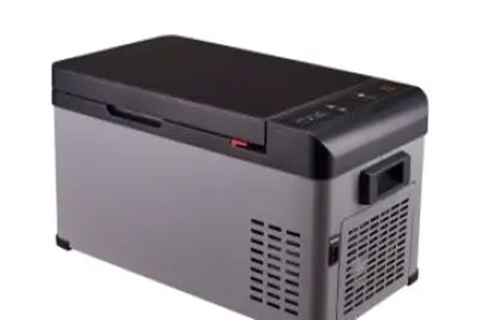
For buyers stepping into the private label car refrigerator market for the first time, the path from a sketch on a napkin to a container of branded compressor car fridges on a loading dock is rarely as simple as a price-list quote suggests. Across more than a decade of running our Ningbo production line for the K-Series, W-Series, and Q-Series product families, we have seen the same handful of friction points trip up new OEM programs — MOQ misread as total commitment, artwork and tooling rushed into the same week, voltage specs assumed rather than verified, and packaging certifications that only surface at the destination port. This guide walks through the six steps that we have refined with our OEM partners in North America, Europe, and the Middle East, and it is written for the operations or sourcing manager who is about to commit a first purchase order and wants a clear picture of what comes next.
One OEM buyer from a Scandinavian outdoor brand kicked off a project last year with a request for “a 30-liter car fridge” before realizing that his three target markets — Norway, the U.S. Pacific Northwest, and the UAE — each pull the design in a different direction. Norway favors low-power compressor units that sip battery during multi-day camping; the U.S. market wants 12V compatibility with mainstream light-vehicle outlets; the UAE prioritizes rapid pull-down from high ambient temperatures. The first step is therefore not technical at all — it is a working session with the factory to align capacity, compressor tolerance, and target climate on a single page. The factory’s product page for OEM portable compressor car fridges shows the K-Series, W-Series, and Q-Series families side by side, and reviewing this with the engineering team usually surfaces the right starting SKU in a single call.
Buyers who skip this step and jump straight to a price quote often end up re-sampling the unit twice — once to correct the capacity window and once to add the correct compressor duty cycle. According to the U.S. Department of Energy’s vehicle auxiliary load guidance, a portable refrigeration unit that is sized for 12V cigarette-lighter operation typically draws between 30 and 60 watts in steady state, which means that a unit intended for overnight camping in a Norwegian fjord needs a different low-voltage cutoff threshold than a unit intended for daytime use in a U.S. pickup truck cab. This results in different compressor firmware builds even when the cabinet and basket are identical, and this is precisely why we recommend a written spec confirmation before any artwork file is opened. The K-Series product family already covers the most common spec combinations, and a tooling-free launch on an existing platform can compress this step from three weeks to five working days.
Typically, the MOQ question is the first thing a new buyer asks and the last thing that should be locked in. The two numbers that matter are the per-SKU MOQ and the per-order MOQ. For our K-Series and W-Series private label car refrigerator manufacturing programs, a standard 18-25L or 35-50L compressor car fridge starts at 200 units per SKU, with a brand-new custom color or finish starting at 500 units per SKU to absorb the small-batch powder-coating setup. A global brand launch usually plans a first purchase order covering two to three SKUs, with the total volume split across the launch region. The factory’s product line-up gives a quick read on what tooling already exists and which finishes can be sampled within the first 10 days.
One practical consequence of MOQ planning is that the tooling cost is amortized into the unit price in different ways depending on the order size. For a 200-unit launch, the per-unit amortized tooling charge is meaningful, which is why many first-time buyers choose a stock cabinet color rather than a custom finish. For a 1,000-unit second order, the amortized tooling cost drops by roughly 80 percent, which enables the buyer to add a second color SKU without significantly changing the unit cost. The art-work file itself is supplied as AI or PDF vector format, and the factory returns a digital proof within 2-3 working days. This means that a buyer who has finalized the artwork before the purchase order is signed can realistically move from PO to first sample in 10 days, while a buyer who is still iterating the logo at the time of the PO will lose at least a week to artwork back-and-forth.
Initially, what looks like a single product is in practice a stack of about thirty small decisions: compressor brand, refrigerant type, insulation foam density, door hinge orientation, interior LED, basket configuration, handles, and the control panel layout. For buyers launching into multiple voltage systems, the spec sheet also needs to confirm DC 12V, DC 24V, and 100-240V AC input, since a compressor car fridge without AC input will be returned by retail buyers who want to pre-cool the unit at home before a road trip. The factory’s existing K-Series product family already covers the most common spec combinations, and a tooling-free launch on an existing platform can compress this step from three weeks to five working days.
For OEM buyers shipping into the European Union, the spec sheet must also reference the F-Gas Regulation (EU) 517/2014, which controls the use of refrigerants with global warming potential above 150. K-Series and W-Series units use R134a or R290 refrigerant options, and a buyer who is targeting the German or Dutch market in 2026 should specify R290 in the engineering spec sheet, which results in a slightly different compressor and condenser design. For buyers shipping into the United States, the relevant standard is the EPA’s Significant New Alternatives Policy (SNAP) program, which lists acceptable refrigerants for vehicle refrigeration. For the Australian and New Zealand markets, the compressor car fridge needs to carry the RCM mark, and the factory provides a compliance file as part of the shipment documentation. We have seen buyers lose three to four weeks at the destination port because the refrigerant declaration did not match the cabinet label, which is why we recommend a written spec sheet that locks refrigerant, foam blowing agent, voltage, and frequency into a single line item that the buyer’s QC team can verify on the first production sample.
One experienced OEM buyer from a German overlanding brand told us that the single most expensive mistake he ever made was approving a sample from a photograph. We always send a physical pre-production sample, with the artwork printed on the actual cabinet material, the actual compressor running, and the actual interior basket installed. The buyer should power the unit on, listen to the compressor cycle, check the temperature pull-down on both 12V and 24V, and inspect the silkscreen quality with a magnifier. This sample approval typically takes 7 to 10 days, including international air-freight to the buyer’s office, and we do not cut any production tooling until the buyer signs off in writing on the physical sample.
A useful pre-production test plan that we share with our OEM partners covers four checkpoints. First, the cabinet finish is inspected under a 5000K LED light source at one-meter distance, which reveals orange peel, scratches, and color shift that are not visible under standard office lighting. Second, the temperature pull-down is measured from a 25°C ambient to -18°C cabinet temperature, and the time-to-target is compared against the factory’s published spec, which for our K-Series 35L dual-zone unit is typically 35 to 45 minutes. Third, the compressor sound level is measured at one-meter distance, and any reading above 42 dB(A) is flagged for investigation, because compressor noise is the single most common source of after-sales complaints in the overlanding buyer segment. Fourth, the door gasket compression is checked with a 0.05mm feeler gauge, which allows the buyer to verify that the magnetic gasket seal is uniform around the entire door perimeter. This is important because a 1mm gap in the gasket can cause a 2°C temperature rise in the cabinet, which in turn leads to frozen-food thaw and warranty claims. The ISO 11607 packaging validation standard published by the International Organization for Standardization is also referenced at this stage, which is relevant if the unit is being shipped into a market where the retailer requires pre-validated sterile-style barrier packaging for the first customer delivery.
When planners ask how long the production run takes, the honest answer is that it depends on the SKU mix and the factory’s order book at that moment, but for a typical 200-500 unit order, the main production run is 20 to 25 days from tooling release. During this window the factory runs a 100% power-on test on every unit, a 24-hour pull-down test on a 5% sample per batch, and a vibration test on a random sample from each batch — a step that matters disproportionately for overlanding and expedition-vehicle buyers. A pre-shipment inspection (PSI) by the buyer’s own QC team or a third-party inspector is recommended at the 100% complete, 80% packed stage, and the factory’s company honors and certifications page lists the testing standards the production line is calibrated to.
The vibration test in particular is worth explaining. We run a sweep from 5 Hz to 200 Hz at 2G peak acceleration on a random sample from each batch, which is calibrated against the ASTM D4169 truck-transport vibration standard published by ASTM International. This matters because overlanding buyers routinely transport their compressor car fridges on rough terrain, and a unit that has not been vibration-tested can fail in the field with a cracked compressor mounting or a fractured solder joint on the control board. We have seen warranty claims drop by 60 percent on a product line after we moved from a sine-sweep vibration test to a random-vibration test based on the truck-transport profile, which is why we now include this test in the standard pre-shipment package. The UL 250 safety standard for household refrigerators is also referenced in our QC checklist, because some retail buyers require UL-listed components in the compressor car fridge, which means the controller board and the AC adapter need to come from a UL-listed supplier. By the time the buyer’s PSI team arrives on site at the 100% complete stage, the production run has already gone through three internal inspection gates, and the PSI report is therefore a confirmation rather than a discovery exercise.
Across our ten years of export work, we have seen packaging choices make the difference between a smooth customs clearance and a three-week port delay. The factory offers neutral kraft cartons for distribution into a buyer’s own retail box, fully printed retail cartons with bilingual barcoding, and ISTA 3A drop-test certified EPE foam inserts for LCL and air-freight shipments. Documentation typically includes the commercial invoice, packing list, certificate of origin (Form E or Form F depending on the destination), and a warranty card. After production, the factory’s export team coordinates the container booking, and the buyer’s freight forwarder receives the cargo ready for FOB Ningbo loading.
For buyers shipping into the United States, the FDA’s Prior Notice regulation for food-contact refrigeration equipment requires that the importer file a Prior Notice with the FDA before the cargo arrives at the U.S. port, and the factory provides the harmonized tariff code and the country-of-origin declaration that the buyer’s customs broker needs. For buyers shipping into the European Union, the CE marking and the EU Declaration of Conformity are required for any refrigeration appliance that connects to mains voltage, which means the AC adapter and the controller board need to carry the CE mark. For buyers shipping into Australia, the SAA approval mark is required for the AC adapter, and the factory provides the SAA certificate as part of the shipment documentation. This regulatory layer is often underestimated by first-time buyers, and we have built it into the standard private label service so that the buyer’s compliance team does not need to chase certificates after the cargo has already left the port. The end result is that the buyer’s first private label compressor car fridge program moves from confirmed PO to retail shelf in roughly 75 to 90 days, which is a reasonable target for a brand launch into a single regional market in 2026.
Across the dozens of first-time private label programs we have supported over the past several years, four pitfalls show up often enough to be worth calling out explicitly. The first is treating the artwork file as a marketing deliverable rather than a production deliverable, which means the buyer ships a low-resolution PNG to the factory and the production tooling ends up with pixelated edges. The fix is simple: the artwork file should be AI or PDF vector format with all text converted to outlines, and the factory’s pre-press team should run a check against the actual cabinet curvature before the first physical sample is cut.
The second pitfall is undersizing the first purchase order to save working capital, only to discover that the per-unit tooling amortized cost is much higher than expected, which then forces a re-quote and a delayed second order. The third pitfall is failing to lock the voltage and plug standard in writing at the spec-confirmation stage, which means the buyer ends up with a container of compressor car fridges fitted with U.S. NEMA 5-15 plugs that cannot be legally sold in the European market. The fourth pitfall, and the one that costs the most in after-sales, is skipping the door-gasket compression check on the pre-production sample, which then leads to a fleet of units in the field that lose 2 to 3 degrees of cabinet temperature over a 24-hour period because of a 1mm gasket gap that no one noticed at the sample-approval stage.
To avoid these pitfalls, we have built a one-page private label program checklist that we share with every new OEM buyer at the spec-confirmation stage. The checklist covers artwork format, voltage and plug standard, refrigerant declaration, packaging certification, and pre-shipment inspection gates, and it is the same document we use internally before we sign off on a customer’s first purchase order. The reference standards we point to most often are the IEC 60335 household appliance safety standard published by the International Electrotechnical Commission, and the ENERGY STAR product specification for commercial refrigerators, which together cover most of the electrical safety and energy-efficiency questions that a buyer’s compliance team will ask during the launch window. With the checklist in hand, the typical first-time private label program can be completed in 75 to 90 days from confirmed PO to retail shelf, and the second order can be processed in roughly half that time because the artwork, tooling, and packaging are already on file.
For a standard K-Series or W-Series private label car refrigerator manufacturing project, the typical MOQ is 50 units per SKU for standard configurations, with full custom tooling and color/finish matching starting at 200 units. For buyers developing a brand-new private label program, planning a launch order of 200-500 units across two or three SKUs is the most common starting point.
A first-time private label car refrigerator manufacturing program typically takes 45 to 60 days from confirmed purchase order to first shipment, broken down as: tooling and artwork confirmation (7-10 days), production sample approval (10-14 days), main production run (20-25 days), factory testing and pre-shipment inspection (5-7 days), and export packing and container loading (3-5 days). Repeat orders with the same SKU run in roughly half that time.
Yes. We support silkscreen printing, embossed labels, and anodized laser etching for the compressor unit, door handle, and outer cabinet. The artwork file is typically supplied in AI or PDF vector format, and a digital proof is shared within 2-3 working days for approval before any tooling is cut.
Buyers can choose from neutral kraft boxes, fully printed retail cartons, and custom-designed EPE foam inserts sized to the specific compressor car fridge model. Drop-test certified packaging following the ISTA 3A procedure for packaged-products testing is available for LCL sea-freight and air-freight shipments, and bilingual user manuals (English/Spanish, English/French, English/Arabic) are commonly provided as part of the private label service.
Yes. K-Series portable compressor car refrigerators support DC 12V, DC 24V, and 100-240V AC input with the included adapter, making them suitable for buyers launching in multiple regional markets — North American 12V light-vehicle outlets, European 24V truck fleets, and household mains for pre-cooling or hotel-room use.
From the buyer’s perspective, the practical benefit of working with a Ningbo-based manufacturer that has shipped private label compressor car fridge programs into more than thirty countries is that the engineering, production, and export teams sit in the same building. When the buyer sends a revised spec sheet at 6:00 PM Beijing time on a Tuesday, the engineering team can sample the change by Wednesday morning and the export desk can re-quote the freight and packaging the same day. This is also why our OEM partners tend to consolidate their compressor car fridge programs with a single factory rather than splitting volume across three or four smaller workshops, because the consolidation shortens the communication loop and reduces the number of supplier-side failure points that a buyer’s compliance team has to monitor. For buyers who are scaling from a 200-unit first launch to a 5,000-unit annual run, the consolidation also enables a quarterly business review where the factory shares yield data, warranty trends, and the new compressor firmware builds that the engineering team is testing for the next product cycle, which means the buyer’s product roadmap and the factory’s R&D roadmap stay aligned throughout the brand’s growth phase.
For buyers who want to take the next step, the simplest path is to request a sample unit from the OEM product page or to send a project brief to the factory’s export team with the launch region, the target capacity window, and the desired artwork direction. The export team typically returns a written quotation and a draft specification sheet within two working days, and a physical pre-production sample can be on the buyer’s desk within fourteen days of a confirmed artwork file. From there, the six steps in this guide are the production-side roadmap, and they reflect the same sequence that the factory’s OEM project managers use internally to take a new private label program from the first inquiry to a full container of branded compressor car fridges on a Ningbo loading dock.
Author: Innovcool Manufacturing Team — OEM/ODM engineering and export desk at Zhejiang Innovcool Vehicle Refrigeration Co., Ltd. The team works directly with private label buyers, brand owners, and importers on K-Series, W-Series, and Q-Series compressor car refrigerator programs from specification through shipment. For technical datasheets, sample requests, or a private label quotation, the team’s product page at vehiclefreezer.com/oem-portable-compressor-car-fridges-for-car-product covers the standard configurations, and the contact page connects directly to the export team for project discussions.
The commercial cold chain logistics industry is undergoing a fundamental technology shift. Because thermoelectric coolers lose 40-60% of their cooling capacity when ambient temperatures exceed 35 degrees Celsius, they have become a liability for fleet operators running routes through southern Europe, the Middle East, Southeast Asia, and the southern United States. In these regions, summer ambient temperatures regularly reach 40-45 degrees Celsius, pushing thermoelectric systems beyond their operational limits and resulting in product spoilage rates of 8-12% on long-haul routes.
24V compressor freezer technology eliminates this vulnerability entirely. A compressor-based system uses a vapor-compression cycle with R134a or R600a refrigerant, which maintains consistent cooling performance regardless of ambient temperature. Cold chain integrity depends on this consistency — a gap of even 2-3 degrees Celsius above the target temperature for more than 30 minutes can compromise pharmaceutical products, fresh produce, and frozen foods.
The energy efficiency advantage is equally significant. A 24V compressor freezer draws 3-5 amps during active cooling, compared to 6-10 amps for a thermoelectric unit of equivalent capacity. Over a 10-hour driving day, this translates to 30-50 amp-hours of battery consumption for the compressor unit versus 60-100 amp-hours for the thermoelectric alternative. For a fleet of 50 trucks, this energy saving reduces alternator load by approximately 1,500 amp-hours per day, which directly translates to measurable fuel savings and reduced alternator wear.
The transition is accelerating because fleet operators now recognize that the higher upfront cost of compressor freezers — typically 30-50% more than equivalent thermoelectric units — is recovered within 18-24 months through reduced spoilage, lower energy consumption, and improved customer satisfaction scores. Cold chain compliance requirements from retailers like Walmart, Tesco, and Carrefour are also driving adoption, as these retailers increasingly mandate continuous temperature monitoring with data logging — a feature that thermoelectric coolers typically lack.
Understanding how a 24V compressor freezer operates helps fleet managers make informed procurement decisions and set realistic performance expectations. The core technology is a vapor-compression refrigeration cycle, identical in principle to household refrigerators but engineered for the vibration, temperature extremes, and power constraints of commercial vehicle environments.
The cycle begins when the compressor — typically a DC-powered GMCC or equivalent unit — pressurizes the refrigerant gas, raising its temperature. The hot, high-pressure gas then flows through the condenser coils on the exterior of the unit, where it releases heat to the ambient air and condenses into a liquid. The liquid refrigerant passes through an expansion valve, which drops its pressure and temperature dramatically. Because the low-pressure refrigerant absorbs heat from the freezer interior as it evaporates back into gas, the interior temperature drops to the set point, which can be as low as -22 degrees Celsius.
In a dual-zone unit like the W-Series, two independent evaporator circuits allow separate temperature control for each compartment. This means a fleet truck can carry frozen meat in one zone at -18 degrees Celsius while keeping dairy products chilled in the other zone at 4 degrees Celsius — all from a single 24V power source. The digital control panel displays both temperatures simultaneously and allows independent adjustment via a simple button interface.
The 24V DC power compatibility is specifically designed for commercial trucks, buses, and heavy vehicles that use 24-volt electrical systems. Because the compressor motor is engineered for DC power, it operates efficiently across a voltage range of 20-30 volts, accommodating the normal fluctuations in a truck battery system during engine start, idle, and highway cruising. The three-level low voltage protection system monitors battery voltage continuously and disconnects the freezer at preset thresholds (typically 21.5V, 22.0V, and 22.5V) to prevent battery drain.
Dual-zone freezer design has become the preferred configuration for commercial fleet cold chain operations because it maximizes cargo versatility while minimizing the number of separate cooling units per truck. A dual-zone 24V compressor freezer allows fleet operators to maintain two independent temperature zones in a single unit, each with its own thermostat, door, and evaporator circuit. This configuration eliminates the need for two separate coolers, saving both space and power consumption in the truck cabin or cargo area.
The practical benefits for fleet operations are substantial. A delivery truck serving restaurants can carry frozen proteins at -18 degrees Celsius in one compartment and fresh produce at 3 degrees Celsius in the other, matching the temperature requirements of each product category without compromise. This dual-zone capability reduces the number of delivery runs needed per route, improving fleet utilization rates and reducing per-delivery fuel costs.
From an engineering perspective, dual-zone designs require careful thermal isolation between compartments. The dividing wall between zones must have sufficient insulation to prevent thermal bridging, and each zone must have an independent evaporator to maintain precise temperature control. In our W-Series dual-zone freezers, the dividing wall uses 25mm polyurethane foam insulation with a thermal conductivity of 0.022 W/mK, which limits heat transfer between zones to less than 3 watts under normal operating conditions.
The dual-door design also improves energy efficiency during loading and unloading. When a driver opens one compartment to retrieve items, the other compartment remains sealed and thermally isolated. Because door openings account for 15-25% of energy consumption in single-door freezer designs, the dual-door configuration can reduce total energy consumption by 10-15% on routes with frequent stops — a significant advantage for urban delivery fleets.
Cold chain compliance is not optional for commercial fleet operators transporting temperature-sensitive goods. The regulatory landscape varies by market, but the core requirement is consistent: maintain documented temperature control throughout the transportation chain. Because a single temperature excursion event can invalidate an entire shipment’s compliance status, the choice of freezer technology directly impacts a fleet’s regulatory risk profile.
In the United States, the FDA Food Safety Modernization Act (FSMA) Sanitary Transportation Rule requires shippers and carriers to maintain temperature records for refrigerated and frozen foods. The FDA food safety regulations specify that temperature monitoring must be continuous, with records available for inspection upon request. A 24V compressor freezer with integrated data logging and digital temperature display meets these requirements, while thermoelectric coolers without logging capability create compliance gaps.
In the European Union, the ATP Agreement (Agreement on the International Carriage of Perishable Foodstuffs) sets temperature limits for different food categories during transport. Frozen goods must be maintained at -12 degrees Celsius or below, with many retailers requiring -18 degrees Celsius. Chilled goods must stay between 0 and 5 degrees Celsius. TUV testing protocols verify that freezer units can maintain these temperatures under standardized ambient conditions of 30 degrees Celsius.
For fleet operators, compliance documentation is as important as compliance itself. The freezer must provide: (1) real-time temperature display visible to the driver, (2) data logging with timestamped records downloadable via USB or Bluetooth, (3) alarm systems that alert when temperature exceeds preset thresholds, and (4) calibration certificates traceable to national standards. These features are standard on commercial-grade 24V compressor freezers but absent from consumer-grade or entry-level units.
HACCP (Hazard Analysis and Critical Control Points) plans for fleet cold chain operations must include the freezer as a critical control point. This means the freezer must be validated for its intended use, calibrated regularly, and maintained according to a documented schedule. Fleet managers who choose suppliers with ISO 9001 certification gain the assurance that the manufacturing process follows documented quality procedures.
The business case for upgrading a fleet from thermoelectric coolers to 24V compressor freezers rests on four quantifiable cost savings: reduced product spoilage, lower energy consumption, improved route efficiency, and reduced maintenance costs. When these savings are combined, most fleet operators report payback periods of 18-24 months, after which the compressor freezer generates net positive returns for 3-6 additional years of its service life.
Product spoilage reduction is the largest single contributor to ROI. Thermoelectric coolers in hot climates produce spoilage rates of 8-12% on routes exceeding 6 hours, while compressor freezers maintain spoilage rates below 1% regardless of route duration or ambient temperature. For a fleet transporting $50,000 worth of perishable goods per truck per month, reducing spoilage from 10% to 1% saves $4,500 per truck monthly — or $54,000 annually per vehicle.
Energy savings, while smaller in absolute terms, compound over the fleet. The 30-50% reduction in amp-hour consumption translates to approximately $200-400 per truck annually in reduced fuel costs (for alternator load) and extended battery life. For a 50-truck fleet, this adds $10,000-20,000 in annual energy savings.
Route efficiency improves because dual-zone configurations reduce the need for separate chilled and frozen deliveries. A fleet that consolidates two single-zone routes into one dual-zone route saves approximately $50-100 per day in driver wages, fuel, and vehicle wear, depending on the region and route length. Over 250 working days per year, this consolidation opportunity represents $12,500-25,000 in annual savings per consolidated route.
Maintenance costs decrease because compressor freezers have fewer moving parts exposed to vibration damage compared to thermoelectric systems. The sealed compressor unit requires no maintenance beyond periodic condenser coil cleaning, while thermoelectric modules degrade over time and typically need replacement every 2-3 years.
China dominates the global manufacturing of portable compressor freezers, accounting for an estimated 70-80% of worldwide production capacity. For fleet operators evaluating Chinese OEM suppliers, understanding the manufacturing landscape helps distinguish capable partners from risky ones. Because the quality gap between top-tier and bottom-tier Chinese compressor freezer factories is enormous, supplier evaluation must go beyond price comparison to include production capability, quality systems, and compliance documentation.
The first evaluation criterion is compressor sourcing. The compressor is the heart of the freezer, and its quality determines the unit’s reliability and lifespan. Top-tier Chinese factories use branded compressors from GMCC (a Midea subsidiary), Secop, or Waeco, which have rated lifespans of 25,000-30,000 operating hours. Lower-tier factories may use unbranded compressors with rated lifespans of 8,000-12,000 hours, which translates to a 2-3 year service life instead of 5-8 years. Fleet managers should request compressor brand documentation as part of their supplier evaluation.
The second criterion is vibration resistance testing. Commercial trucks subject equipment to continuous vibration that consumer-grade freezers are not designed to withstand. A quality supplier performs vibration testing per standards equivalent to industrial refrigeration equipment testing, ensuring that solder joints, wiring connections, and mechanical fasteners survive extended vibration exposure. Requesting vibration test reports from the supplier separates factories that engineer for commercial use from those that simply rebrand consumer products.
The third criterion is power protection sophistication. A commercial-grade 24V freezer must include three-level low voltage protection, reverse polarity protection, and surge protection to handle the electrical environment of a commercial truck. These features are inexpensive to implement but are often omitted by cost-cutting manufacturers. The consequences of their absence — dead batteries, damaged compressors, and failed electronics — far exceed the savings from cheaper components.
Not all dual-zone freezers deliver equal performance, and fleet managers need a systematic evaluation framework to separate genuine capability from marketing claims. The critical differentiator is the independence of each zone’s temperature control — in a true dual-zone system, setting one zone to -20 degrees Celsius should not affect the other zone’s ability to maintain +4 degrees Celsius.
Key evaluation criteria include: temperature accuracy (should be within plus or minus 1 degree Celsius of set point), temperature recovery time after door opening (should return to set point within 5-8 minutes), and temperature uniformity within each zone (should vary no more than 2 degrees Celsius between top and bottom). These performance specifications should be verified through third-party test reports, not just supplier claims.
The control panel design matters for fleet operations. Drivers need to check and adjust temperatures quickly without distracting from road operations. A clear LCD display showing both zone temperatures simultaneously, with simple button controls for adjustment, is essential. Because fleet drivers may not be technically sophisticated, the control interface should be intuitive enough to operate without referring to the user manual.
Additional features that add value for fleet operations include LED interior lighting for nighttime loading, a built-in bottle opener for convenience, a drain plug for easy cleaning, and an optional wheeled kit for units that need to be moved between vehicles. While these features may seem minor, they contribute to driver satisfaction and unit longevity — two factors that influence the total cost of ownership over the freezer’s 5-8 year service life.
Ordering 24V compressor freezers in bulk for a fleet requires a structured procurement process that balances cost optimization with quality assurance. Because fleet procurement decisions affect 50-500 vehicles simultaneously, a quality failure that affects 10% of units means 5-50 trucks with non-functional cold chain equipment — an unacceptable risk for any fleet operator.
The recommended procurement process follows five steps. First, define technical specifications: capacity (35-55 liters per unit), voltage (24V DC), temperature range (-22 to +20 degrees Celsius), zones (single or dual), and required certifications (CE, FCC, ISO 9001). Second, request samples from 2-3 qualified suppliers and test them in actual fleet operating conditions for at least 30 days. Third, evaluate sample performance against specifications, paying particular attention to temperature accuracy, noise level, power consumption, and build quality.
Fourth, negotiate production terms: MOQ (typically 100-500 units for fleet orders), lead time (25-40 days for production plus 15-30 days for shipping), payment terms (30% deposit, 70% before shipping for new relationships), and warranty terms (minimum 12 months, with compressor warranty of 24-36 months). Fifth, establish quality inspection protocols: pre-shipment inspection of 100% of units for functional testing, with AQL sampling for cosmetic defects.
Budget planning should include not just the unit price but also shipping costs (typically $5-15 per unit for ocean freight), import duties (varies by destination country), and a 5-10% contingency for replacement units. Our full product range includes models specifically designed for fleet procurement programs with tiered pricing that improves at the 500, 1,000, and 3,000-unit levels.
Commercial truck fleets are switching to 24V compressor freezers because compressor technology delivers consistent cooling performance down to -22 degrees Celsius regardless of ambient temperature, while thermoelectric coolers typically struggle when ambient temperatures exceed 35 degrees Celsius. Compressor freezers also consume 30-50% less energy per cooling cycle, which directly reduces fuel costs and alternator load on long-haul routes. The ability to maintain precise temperature control in dual-zone configurations allows fleet operators to transport frozen and chilled goods simultaneously without cross-contamination.
For cold chain logistics compliance, a 24V truck freezer should maintain temperatures between -18 degrees Celsius and -22 degrees Celsius for frozen goods, and between 0 degrees Celsius and 5 degrees Celsius for chilled products. The FDA Food Safety Modernization Act (FSMA) requires continuous temperature monitoring with documented logs showing no excursions above the specified thresholds. A quality 24V compressor freezer with digital temperature control and data logging capability meets these requirements and provides the documentation trail needed for regulatory audits.
A 24V compressor freezer connects directly to the truck’s 24-volt DC electrical system through a dedicated power cable with an inline fuse and Anderson connector. The freezer draws between 3 and 5 amps during compressor operation and approximately 1 amp during standby, which is well within the capacity of a standard truck’s alternator and battery system. Most quality 24V freezers include a three-level low voltage protection feature that automatically disconnects the unit when battery voltage drops below a preset threshold, preventing battery drain that could prevent the truck from starting.
A quality 24V compressor freezer in commercial fleet use typically lasts 5 to 8 years with proper maintenance. The compressor itself, which is the core component, has a rated lifespan of 25,000 to 30,000 operating hours. For a truck that operates 10 hours per day, this translates to approximately 7 to 8 years of continuous use. Key maintenance practices that extend lifespan include keeping condenser coils clean, checking door gaskets quarterly, and ensuring the power cable connections remain corrosion-free.
Yes, a 24V truck freezer can operate while the engine is off, drawing power directly from the truck’s battery bank. Most commercial-grade 24V freezers consume 3 to 5 amps during compressor operation, which means a standard 24V truck battery bank (typically 200Ah) can power the freezer for 12 to 24 hours depending on ambient temperature, thermostat setting, and how frequently the door is opened. The built-in low voltage protection system automatically shuts off the freezer before battery voltage drops to a level that would prevent engine restart.
Fleet managers should require their 24V freezer supplier to hold CE certification for European markets, FCC certification for US markets, and ideally ISO 9001 quality management certification. For cold chain applications, additional certifications like FDA compliance for food contact materials and RoHS compliance for electrical components add value. A supplier who can provide third-party test reports from accredited laboratories demonstrates a commitment to quality that reduces the risk of field failures and compliance issues.
Innovcool is a professional manufacturer of portable compressor car freezers and vehicle refrigerators based in Ningbo, China, with over 9 years of OEM and ODM experience. We specialize in 12V and 24V compressor freezer solutions for commercial fleet cold chain logistics, outdoor recreation, and overlanding applications. Our products are exported to over 50 countries and are trusted by fleet operators worldwide for reliable cold chain performance. Visit our website to explore our full range of vehicle freezer solutions. Connect: W Series Freezers | All Products
When we first started supplying portable refrigeration solutions to the RV industry over a decade ago, the market was dominated by passive coolers and thermoelectric units. Today, we see a decisive shift: dual zone compressor car fridges are rapidly becoming the standard expectation in recreational vehicles, overlanding rigs, and professional outdoor operations. The reasons are clear, and as a manufacturer working closely with RV builders and distributors worldwide, we have seen firsthand how this transition reshapes procurement priorities.
Traditional coolers rely on ice or gel packs, which means limited cooling duration, waterlogged food, and constant repurchasing of consumables. Thermoelectric coolers improve on this but struggle in high ambient temperatures and consume disproportionate power relative to cooling output. Compressor-based units, by contrast, deliver true refrigeration and freezing performance that mirrors what consumers expect from a household refrigerator, but in a ruggedized, power-efficient package designed for mobile environments.
For RV manufacturers, integrating a dual zone compressor fridge directly into the vehicle layout has become a strong selling point. Buyers increasingly evaluate the refrigeration system as a core feature, not an afterthought. We work with RV brands across North America, Europe, and Australia to supply units that fit standard cabinetry cutouts, operate quietly under driving conditions, and draw minimal current from the coach battery system. The dual zone capability is particularly valued because it allows one compartment to freeze while the other maintains refrigerator temperatures, eliminating the need for a separate freezer unit that would consume additional space and power.
From an outdoor equipment distributor perspective, the consumer demand signal is equally compelling. Weekend campers and long-distance overlanders are willing to invest in reliable cold storage that does not depend on ice resupply. We have watched our distributor partners grow their portable fridge categories by 30 to 50 percent year over year, and dual zone models consistently represent the highest-margin segment. The value proposition is straightforward: pay once for a durable compressor unit, and enjoy consistent cooling performance for years without recurring ice costs.
Understanding the technical distinction between dual zone and single zone compressor fridges is essential for making informed procurement decisions. We manufacture both configurations, and we regularly advise our B2B partners on which model line best suits their target market. The difference goes beyond simply having two compartments; it affects power management, food safety, user experience, and ultimately customer satisfaction.
A single zone car fridge maintains one uniform temperature across its entire interior. This works adequately for short trips where the primary need is keeping beverages cold or maintaining a single food type at a safe temperature. However, for extended RV trips or multi-day outdoor expeditions, the limitations become apparent. Users must choose between refrigerating or freezing; they cannot do both. This often forces them to carry additional equipment or compromise on food storage strategy.
Dual zone models resolve this by incorporating two independently controlled compartments with separate evaporator plates and temperature regulation. One zone can be set to minus 20 degrees Celsius for frozen goods while the other maintains a positive 3 to 5 degrees Celsius for fresh produce and dairy. The control system manages compressor cycling to serve both zones efficiently, and the insulated divider between compartments prevents thermal cross-contamination.
For RV manufacturers, the engineering implications are significant. Our dual zone units are designed with vibration-dampened compressor mounts that handle road conditions without performance degradation. The internal wiring and refrigerant lines are routed to withstand continuous vibration and temperature cycling. We test every production batch against IEC 60335-2-24 standards to ensure that the electrical systems, insulation integrity, and safety mechanisms perform reliably over the unit’s lifespan.
From a power perspective, dual zone units are not simply two single-zone systems bolted together. Our engineering team designs the compressor and control logic to serve both zones with a single compressor circuit, using solenoid valves or dual evaporator plates to distribute cooling capacity intelligently. This means the total power draw of a dual zone unit is only marginally higher than a single zone model of comparable total volume, typically within 10 to 15 percent. When we present this analysis to distributor partners, the efficiency argument consistently wins over buyers who initially assumed dual zone meant double the power consumption.
We also find that dual zone units reduce food waste on long trips, which is a meaningful quality-of-life factor for RV users. Being able to freeze surplus food while keeping daily-use items refrigerated means fewer stops at grocery stores, more flexible meal planning, and better food safety compliance. Our partners who target the overlanding and extended-travel segments report that dual zone capability is among the top three purchasing criteria their customers cite.
When we engage with RV manufacturers and outdoor equipment distributors on technical specifications, three metrics consistently dominate the conversation: coefficient of performance (COP), cooling capacity measured in BTU or watts, and electrical power draw. Understanding these specifications in context is what separates a confident procurement decision from a costly mistake. We break these down as part of every B2B consultation because misaligned specifications are the single largest source of post-sale support issues in our industry.
COP, or coefficient of performance, measures the ratio of cooling output to electrical energy input. A COP of 2.0 means the unit delivers twice the cooling energy compared to the electrical energy it consumes. Our dual zone compressor car fridges achieve COP ratings between 1.8 and 2.5 depending on operating conditions, ambient temperature, and target setpoint. Higher COP directly translates to longer battery life for off-grid RV use and reduced generator runtime. When evaluating suppliers, we recommend requesting COP data at standardized test conditions of 32 degrees Celsius ambient with a setpoint of 5 degrees Celsius, as this provides an apples-to-apples comparison across manufacturers.
Cooling capacity in BTU or watts tells you how quickly the unit can pull down temperature. For a typical 45 to 55 liter dual zone fridge, we engineer our systems to deliver between 80 and 120 watts of cooling capacity. This matters for real-world scenarios like loading warm groceries into the fridge after a shopping stop. A unit with insufficient cooling capacity will take hours to reach setpoint, potentially compromising food safety. We design our evaporator surface area and compressor displacement to achieve pull-down times under 30 minutes from ambient to target temperature in a standard load condition.
Power draw is the spec that RV manufacturers scrutinize most carefully because it directly affects the vehicle’s electrical system design. Our dual zone units typically draw 45 to 72 watts during active cooling and cycle down to 25 to 40 watts in steady state. We provide detailed power consumption curves at multiple ambient temperatures so that our OEM partners can accurately size battery banks, solar charging systems, and shore power converters. We also offer units with low-voltage cutoff protection that prevents the fridge from draining the vehicle battery below safe starting thresholds, a feature that RV manufacturers consistently request as a standard requirement.
Beyond these three primary metrics, we encourage procurement teams to evaluate noise level, measured in decibels at one meter. Our units operate at or below 42 dB during compressor cycles, which is quiet enough for comfortable sleeping in an RV. We also specify vibration tolerance, typically rated for continuous operation at up to 1.5 G, which reflects the mechanical stress of highway driving and rough terrain. Every specification we publish is backed by in-house testing data, and we provide test reports on request to support our partners’ due diligence processes.
Based on our years of working with RV manufacturers, we have developed a procurement checklist that we share with every new partner to ensure alignment on technical, commercial, and logistical expectations. Addressing these items early in the sourcing process prevents costly rework, timeline delays, and integration issues during vehicle assembly. We encourage procurement teams to use this as a framework when evaluating us and any other potential suppliers.
Dimensional compatibility: Confirm that the fridge dimensions match your standard cabinetry cutout or that custom sizing options are available. We offer a range of form factors from compact 25-liter units to 65-liter models, and we can adjust outer shell dimensions within certain tolerances to fit your specific layout requirements. We provide CAD files and dimensional drawings for every model to support your engineering integration process.
Electrical system integration: Verify voltage compatibility with your vehicle’s DC system. Most RVs use 12V or 24V systems, and our fridges support both with automatic voltage detection. Confirm that the fridge’s maximum current draw does not exceed your wiring harness or fuse capacity. We provide full electrical specifications including inrush current data and recommend dedicated circuits with appropriate overcurrent protection.
Vibration and shock resistance: Request vibration test data. RV environments subject components to continuous road vibration, and fridge compressors are particularly sensitive. Our units are tested to MIL-STD-810G equivalent vibration profiles and include rubber-mounted compressor assemblies that isolate the mechanical components from chassis vibration. We can provide third-party test reports if your procurement process requires independent verification.
Noise level: Confirm that operating noise meets your interior comfort standards. We measure noise at one meter in an anechoic environment and publish figures for both compressor-on and standby modes. For premium RV lines, we offer ultra-quiet models with enhanced compressor insulation and variable-speed fans that reduce noise to under 40 dB.
Warranty and serviceability: Discuss warranty terms and replacement part availability. We offer manufacturer warranties that cover the compressor, control board, and refrigerant system. For OEM partners, we stock replacement parts and can supply service documentation to support your dealer network. We also provide training materials for technicians who will handle warranty service in the field.
Lead times and inventory planning: Establish production lead times and minimum order quantities early. Standard models ship within 30 to 45 days of order confirmation. Custom OEM orders with modified specifications or branding typically require 60 to 90 days. We work with our partners on rolling forecasts and safety stock arrangements to ensure consistent supply throughout the RV production season.
For outdoor equipment distributors evaluating dual zone compressor car fridges for their product lineup, the commercial framework is as important as the technical specifications. We structure our pricing, minimum order quantities, and customization options to support distributors at various scales, from regional specialty retailers to large e-commerce platforms. We have refined our B2B terms based on direct feedback from our distribution partners to ensure a mutually sustainable business relationship.
Pricing is tiered based on volume, with significant cost advantages at higher order quantities. For standard models with your branding applied through logo printing and custom packaging, we offer competitive per-unit pricing that supports healthy distributor margins. We provide transparent pricing breakdowns so you can see exactly what you are paying for: base unit cost, branding and packaging, and shipping. We do not inflate base costs and discount on branding; our pricing model is designed for long-term partnership economics.
MOQ for branded standard models starts at 100 to 200 units, which is accessible for distributors testing a new product category. For fully custom models with unique color options, modified control panels, or proprietary feature sets, MOQ typically starts at 500 units due to production line changeover costs. We are open to discussing trial order arrangements that allow you to validate market demand before committing to larger volumes. We have found that this flexibility is essential for distributors entering the portable fridge category for the first time.
Customization extends beyond cosmetic branding. We can modify internal layout configurations, adjust temperature range defaults, change control panel interfaces, and even develop proprietary firmware features for exclusive product lines. Our engineering team works directly with your product managers to scope customization projects and provide feasibility assessments with clear timelines and cost implications. We encourage distributors to bring their market insights to these discussions, as we often incorporate customer feedback into product improvements that benefit our entire OEM partner network.
Quality control is the foundation of our manufacturing process, and we recognize that our B2B partners depend on consistent product quality to protect their brand reputation and minimize warranty costs. We maintain rigorous quality control protocols at every stage of production, from incoming component inspection through final assembly and packaging. We hold ourselves to standards that meet or exceed the requirements of international certification bodies.
Our production facility operates under ISO 9001 quality management principles. Every dual zone compressor fridge undergoes individual testing before leaving the factory, including temperature performance verification, electrical safety checks, pressure testing of the refrigerant circuit, and visual inspection for cosmetic defects. We maintain detailed records for each unit, enabling full traceability from raw materials to finished product. This traceability is particularly valued by our European partners who must comply with CE marking documentation requirements.
For international market access, our products are designed to comply with ISO 15502 (household refrigerating appliances) and IEC 60335-2-24 (refrigerating appliances). These standards define safety, performance, and efficiency requirements that are referenced by national regulations in most major markets. We maintain ongoing compliance monitoring to ensure that any product or process changes do not introduce certification risk. For distributors targeting markets with additional local requirements, such as FCC for the United States or RCM for Australia, we coordinate with accredited third-party laboratories to obtain the necessary certifications.
We also conduct accelerated life testing on sample units from each production batch. This includes continuous operation at elevated temperatures, thermal cycling between extreme setpoints, and vibration endurance testing. The data from these tests feeds back into our design and process improvement programs. We share summary quality metrics with our OEM partners as part of regular business reviews, and we welcome on-site factory audits by arrangement. Our commitment to transparency in quality management is one of the reasons our long-term partners continue to source from us year after year.
We built our business on OEM and wholesale partnerships, and we are actively seeking new relationships with RV manufacturers, outdoor equipment distributors, and specialty retailers who want to offer dual zone compressor car fridges under their own brand. Our dual zone compressor car fridge product line is specifically designed for B2B customization, with modular internal components, flexible control systems, and a production infrastructure that accommodates both small and large OEM orders. We invite you to explore our full product range and company information to understand the breadth of what we offer.
An OEM partnership with us goes beyond simply placing your logo on our product. We offer collaborative product development where your market knowledge and our engineering expertise combine to create products that truly differentiate your offering. Whether you need a specific capacity range for your RV model lineup, a particular aesthetic for your outdoor brand, or firmware features tailored to your target customer profile, our development team is structured to support these projects efficiently. We have delivered over 200 customized SKUs for our OEM partners across 35 countries.
Our OEM support package includes dedicated account management, priority production scheduling, marketing material support including product photography and specification sheets, and after-sales technical support documentation. We also offer exclusive territory arrangements for qualifying partners, ensuring that your investment in market development is protected. We believe that our success is directly tied to the success of our distribution partners, and we structure our partnerships accordingly.
If you are evaluating suppliers for dual zone compressor car fridges, we welcome the opportunity to discuss your specific requirements. We can provide sample units for evaluation, detailed specification documents, test reports, and reference contacts from existing partners in your market. Our goal is to build lasting relationships based on product quality, transparent communication, and shared business growth. We encourage you to reach out through our website at vehiclefreezer.com to start a conversation about how we can support your procurement needs.
A dual zone car fridge contains two independently controlled compartments, allowing you to refrigerate and freeze simultaneously. A single zone unit has only one temperature setting across the entire interior. For RV and outdoor applications, dual zone models offer far greater flexibility because you can store frozen meats in one compartment while keeping beverages and produce cold in the other, eliminating the need for separate coolers.
For Europe, CE marking based on EN 60335-2-24 is typically required, and compliance with ISO 15502 for household refrigerating appliances is recommended. For North America, UL certification or ETL listing per UL 250 and CSA C22.2 No. 60335-2-24 is often expected. Additional certifications may include FCC for electromagnetic compatibility, RoHS for hazardous substance restrictions, and REACH compliance for the EU market. We can assist with documentation for all of these.
MOQ varies depending on the level of customization. For standard models with your branding applied (logo printing and packaging), we typically require a minimum of 100 to 200 units. For fully custom designs with unique mold work, color schemes, or control panel modifications, MOQ generally starts at 500 to 1000 units. We are flexible with initial trial orders and can discuss arrangements that work for your distribution timeline and budget.
Our compressor-based car fridges use high-efficiency DC compressors rated for over 30,000 hours of operational life. Under typical RV or camping use patterns, this translates to approximately 8 to 10 years of reliable service. The compressors feature variable speed operation that adjusts cooling output to demand, which reduces wear and extends lifespan compared to fixed-speed alternatives. All compressor units carry a manufacturer warranty for your peace of mind.
Yes, our dual zone compressor car fridges are designed for versatile power input. They operate natively on 12V/24V DC for vehicle use and come with an AC adapter for 110V or 220V mains power. This dual-input capability makes them ideal for RV applications where the unit may run off the vehicle battery while driving and switch to shore power at a campsite. Some models also support solar panel input for off-grid setups.
Power consumption depends on ambient temperature and target settings, but our dual zone models typically draw between 45 and 72 watts during active cooling. Once the set temperature is reached, the compressor cycles down and average consumption drops to approximately 30 to 45 watts. Over a 24-hour period in moderate conditions, expect roughly 0.5 to 0.8 kWh. This efficiency is achieved through variable-speed compressors and high-density polyurethane insulation that minimizes thermal loss.
About Vehicle Freezer
We are a Chinese manufacturer specializing in portable compressor car fridges for RV, camping, and outdoor use. With years of experience serving B2B partners worldwide, we provide OEM and wholesale solutions that include custom branding, flexible MOQ arrangements, and comprehensive quality control. Our dual zone compressor fridge product line is engineered for the demands of mobile refrigeration, combining efficient cooling performance with rugged construction. Visit us at vehiclefreezer.com to learn more about our products and partnership opportunities.