Key Takeaways
- The Innovcool W Series car refrigerator operates on DC 12V/24V natively with optional 220V AC adapter, covering both vehicle and mains power for European RV OEM integration.
- Dual-zone models (W-35 series) maintain independent temperatures in each compartment, cooling from 20°C to 0°C in 25 minutes with average power consumption of 50W.
- 3-level low voltage battery protection (8.5V/11.4V/12.4V thresholds) prevents vehicle battery drain — critical for RVs parked for extended periods.
- All models operate below 45 dB, comparable to a quiet library, suitable for overnight use in RV sleeping areas.
- Innovcool offers 9+ years of OEM/ODM experience with 5-7 day sample lead time and 30-40 day mass production.
When European RV manufacturers evaluate compressor car refrigerators for OEM integration, the voltage question comes first. European motorhomes operate on a dual-voltage ecosystem — a system documented in the UNECE vehicle regulations framework: DC 12V or 24V from the vehicle battery while driving, and 220V AC from campground hookups or inverter systems while parked. A refrigerator that only handles one voltage forces the OEM to add external adapters or voltage converters — adding cost, complexity, and a potential failure point in the supply chain. The Innovcool W Series car refrigerator was designed specifically to solve this dual-voltage challenge.
I have worked with RV OEMs across Europe for years, and the specification that separates a viable OEM refrigerator from a rejected sample is not cooling performance — most compressor fridges can reach -22°C. It is the electrical compatibility. The W Series accepts DC 12V and DC 24V natively with automatic voltage detection, and an optional 220V AC adapter allows the same unit to run from European campground mains. This means the OEM specifies one refrigerator model for the entire European market, regardless of whether the motorhome is a compact campervan on a Fiat Ducato chassis (12V) or a large integrated motorhome on an Iveco Daily chassis (24V).
Why Wide-Voltage Compatibility Matters for European RV OEMs
European motorhome electrical systems are not standardized to a single voltage. Compact campervans built on Fiat Ducato, Peugeot Boxer, or Citroen Jumper chassis use 12V DC systems. Larger integrated motorhomes on Mercedes Sprinter, Iveco Daily, or MAN TGE chassis often use 24V DC systems. Additionally, most European campsites provide 220V AC hookups, and many motorhome owners install inverters that convert battery DC to mains AC for appliances.
An OEM that must source separate 12V and 24V refrigerator SKUs for different chassis platforms faces doubled inventory complexity, separate quality validation for each SKU, and potential supply chain disruptions if one voltage variant is delayed. The W Series eliminates this complexity by accepting both DC 12V and DC 24V through a single auto-sensing input — the refrigerator detects the connected voltage and adjusts internally without operator intervention. The optional 220V AC adapter then covers the campground hookup scenario, meaning one SKU serves all three power sources.
This single-SKU advantage is particularly valuable for European OEMs operating under EU type-approval regulations (2018/858), where each vehicle variant requires separate documentation. Reducing the number of refrigerator variants simplifies the type-approval paperwork and reduces the OEM’s compliance burden.
W Series Product Range: From Compact Campervans to Large Motorhomes
The Innovcool W Series car refrigerator range covers the full spectrum of European motorhome sizes, from compact two-person campervans to family-size integrated motorhomes. The range includes four product lines, each optimized for different OEM integration scenarios.
W-18 Series: Compact Single-Zone (18L/25L)
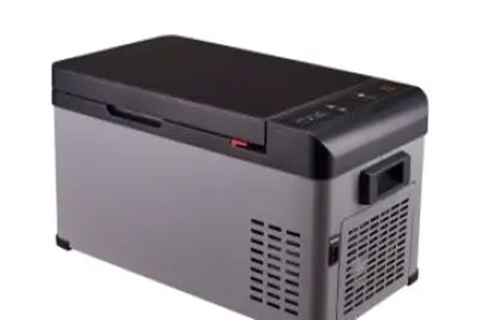
The W-18 series is designed for compact campervans and van conversions where interior space is at a premium. At 616 x 340 x 338mm (18L model), it fits standard campervan kitchen units designed for the European market. The GMCC compressor cools from +20°C to -22°C, with ECO and MAX operating modes. Average power consumption is low enough to run from a 100Ah leisure battery for extended periods without solar recharge. The unit weighs 12.7 kg (net weight), making it manageable for single-person installation during the vehicle build process.
W-40 Series: Mid-Size Single-Zone (40L/50L/60L)
For larger motorhomes with dedicated kitchen or storage compartments, the W-40 series offers 40L, 50L, and 60L capacities. The DL wheeled variants (W-40DL through W-60DL) include detachable wheels and a telescopic pull handle, allowing the refrigerator to be removed from the vehicle for cleaning or used as a standalone cooler at the campsite. The standard dimensions of 670 x 406 x 440mm (40L) fit the DIN standard compartment sizes used by European motorhome furniture manufacturers.
W-35 Series: Dual-Zone (35L/45L/55L)
The W-35 series is the flagship for RV OEM integration. Dual-zone design means the refrigerator maintains independent temperatures in each compartment — one zone for fresh food at +4°C and one for frozen items at -18°C, simultaneously. This eliminates the need for a separate freezer unit in space-constrained motorhome layouts. The compressor cools from 20°C to 0°C in approximately 25 minutes, with average power consumption of 50W. The 3-level battery protection system (low/medium/high thresholds at 8.5V, 11.4V, and 12.4V for 12V systems) prevents the refrigerator from draining the vehicle battery below the level needed to start the engine.
For OEMs, the W-35 series offers the best balance of capacity, functionality, and integration flexibility. The dual reversible doors allow the OEM to configure door opening direction to match the motorhome layout — critical for European motorhomes where kitchen configurations vary significantly between manufacturers.
W-35S Series: Dual-Zone with Separate Doors (35L/45L/55L)
The W-35S series takes the dual-zone concept further by providing two completely separate doors instead of a single reversible door. This allows independent access to each zone without opening the other — reducing cold air loss and improving energy efficiency. For motorhome OEMs targeting the premium segment, the separate-door design provides a more appliance-like appearance that aligns with the expectations of European motorhome buyers.
220V AC Adapter: Bridging Vehicle and Campground Power
The optional 220V AC adapter is the component that completes the European motorhome power ecosystem. When the motorhome is parked at a campsite with electrical hookup, the refrigerator switches from battery DC power to mains AC power through the adapter. This is not just a convenience feature — it is an operational requirement for European RV use, where motorhomes may be parked at a campsite for weeks and relying solely on battery power is not practical.
The adapter is designed as a separate accessory rather than an integrated component because European motorhome OEMs prefer to offer it as an optional upgrade. This keeps the base refrigerator cost competitive while allowing the OEM to bundle the adapter with premium motorhome packages. The adapter connects to the refrigerator’s DC input socket and converts 220V AC to the appropriate DC voltage internally.
OEM Integration Note: When specifying the W Series for a motorhome model, confirm the chassis electrical system voltage (12V or 24V) and the expected campground hookup standard (230V AC in most of Europe, 220V AC in some regions). The W Series handles voltage variation automatically, but the OEM’s wiring harness must be specified correctly during vehicle design.
Battery Protection: Preventing the Dead-Battery Problem
The single most common service complaint from motorhome owners — after water system issues — is a flat vehicle battery caused by a refrigerator that ran too long while the vehicle was parked. The W Series addresses this with a 3-level low voltage battery protection system that monitors the input voltage and disconnects the compressor before the battery drops below a safe starting threshold.
The three protection levels are:
- Low (8.5V for 12V systems): The most aggressive protection — disconnects the compressor at 8.5V to preserve maximum battery charge. Recommended for motorhomes parked for extended periods without charging.
- Medium (11.4V for 12V systems): A balanced setting that provides good battery protection while maintaining longer cooling cycles. The default setting for most OEM installations.
- High (12.4V for 12V systems): The least aggressive protection — allows the compressor to run until the battery is closer to its nominal voltage. Used when the motorhome has a dedicated leisure battery that does not need to start the engine.
For 24V systems, the thresholds are proportionally higher. The protection system is adjustable by the user through the LCD control panel, which also displays the current voltage reading — allowing the motorhome owner to monitor battery health in real time.
Noise and Vibration: The Overnight Use Requirement
European motorhome owners frequently sleep in the same compartment as the refrigerator — unlike commercial vehicle applications where the driver is separated from the cargo area. This makes noise level a critical specification for RV OEM integration, and the W Series is engineered to operate below 45 dB across all models.
The GMCC compressor used in the W Series is designed for low-vibration operation with rubber isolation mounts that decouple the compressor from the refrigerator chassis. The result is a hum that is comparable to a quiet library — noticeable if you listen for it, but not disruptive to sleep. The ECO mode further reduces noise by running the compressor at lower speed during nighttime hours, trading slightly slower temperature recovery for quieter operation.
For RV OEMs, this noise specification is important for two reasons. First, it directly affects customer satisfaction — a noisy refrigerator is one of the most common complaints in motorhome owner forums. Second, some European motorhome certification programs include noise testing per ISO 362-1 acoustic standards as part of the comfort evaluation, and a refrigerator that exceeds 50 dB can cause the vehicle to fail the noise assessment.
OEM Integration: Dimensions, Mounting, and Customization
For RV OEMs integrating the W Series into production motorhome models, the physical dimensions and mounting options are as important as the cooling performance. The W Series is designed with OEM integration in mind:
- Standard dimensions: The W-18 (616 x 340 x 338mm) and W-40 (670 x 406 x 440mm) fit the compartment sizes used by major European motorhome furniture system manufacturers including Dometic, Thetford, and Smev.
- Reversible doors: All models feature reversible doors that can be configured for left or right opening during installation — matching the motorhome kitchen layout without requiring a separate SKU.
- Removable baskets and drain plug: Interior organization components are removable for cleaning, and a built-in drain plug simplifies defrosting and maintenance.
- Reinforced handles: The impact-resistant exterior with reinforced handles is rated for 30° inclination — important for motorhomes parked on uneven campsites or driving on mountain roads.
Innovcool provides OEM customization including custom branding (logo, color, packaging), feature configuration (selecting which accessories to include), and documentation packages for European type-approval submissions. Sample lead time is 5-7 days, with mass production lead time of 30-40 days after order confirmation. Payment terms are T/T 30% deposit with balance before loading, or L/C at sight for established accounts.
For detailed specifications across the full range, visit the W Series car refrigerator product page. For compact models suited to smaller campervans, see the DC12/24V compressor electric cooler. For caravan-specific guidance, the caravan fridge resource page provides sizing and installation recommendations.
Comparison: W Series vs Thermoelectric Coolers for RV Use
A question I frequently receive from RV OEMs is whether thermoelectric (Peltier) coolers are a viable alternative to compressor-based refrigerators for motorhome applications. The answer depends on the use case, but for the majority of European motorhome applications, compressor technology is the clear choice.
| Feature | Compressor (W Series) | Thermoelectric |
| Temperature range | +20°C to -22°C | +20°C to about 0°C (20°C below ambient) |
| Performance in 35°C+ ambient | Maintains setpoint reliably | Struggles to cool below 10°C |
| Power consumption | 45-50W average | 60-80W continuous |
| Noise level | Below 45 dB | 40-50 dB (fan noise) |
| Freezing capability | Yes (-22°C) | No |
| Battery protection | 3-level adjustable | Not typically included |
| Weight (40L capacity) | ~16 kg | ~10 kg |
The critical differentiator for European motorhome use is performance in high ambient temperatures. European summer temperatures in southern France, Spain, Italy, and Greece regularly exceed 35°C, as documented by the European statistical office Eurostat climate data, and the interior of a parked motorhome can reach 50°C or more. A thermoelectric cooler rated at “20°C below ambient” will cool to 30°C in a 50°C vehicle interior — which is not food-safe. The W Series compressor maintains its -22°C setpoint regardless of ambient temperature, because the compressor-based refrigeration cycle is not dependent on the temperature differential between the interior and exterior.
Frequently Asked Questions
What voltage does the Innovcool W Series car refrigerator operate on?
The W Series operates on DC 12V and DC 24V natively, with automatic voltage detection — the refrigerator senses the connected voltage and adjusts internally. An optional 220V AC adapter allows operation from standard European campground mains power, covering the complete motorhome power ecosystem. This means a single refrigerator SKU serves 12V campervans, 24V integrated motorhomes, and 220V campground hookups.
What is the temperature range of the W Series car fridge?
All W Series models cool from +20°C to -22°C. The dual-zone W-35 series maintains independent temperatures in each compartment simultaneously — for example, +4°C for fresh food in one zone and -18°C for frozen items in the other. The compressor cools from 20°C to 0°C in approximately 25 minutes, with ECO mode for energy-efficient overnight operation and MAX mode for rapid cooling when loading warm groceries.
How much power does the W Series consume?
Average power consumption is 50W for the W-35 dual-zone series and 45W for the K Series compact models. In ECO mode, power consumption drops further by running the compressor at lower speed. For a typical European motorhome with a 100Ah leisure battery, the W Series can operate for approximately 20-24 hours on battery alone before requiring recharge — though actual runtime depends on ambient temperature, door opening frequency, and the selected temperature setpoint.
Is the W Series suitable for European RV OEM integration?
Yes. The W Series is designed for RV OEM integration with DC 12V/24V compatibility matching European vehicle electrical systems, 3-level low voltage battery protection to prevent vehicle battery drain, compact dimensions that fit standard RV kitchen compartments, and reversible doors for layout flexibility. Innovcool provides OEM customization including branding, feature configuration, and documentation for European type-approval submissions.
What is the noise level of the Innovcool compressor car fridge?
All W Series and K Series models operate below 45 dB — comparable to a quiet library. The GMCC compressor uses rubber isolation mounts to decouple vibration from the refrigerator chassis. ECO mode further reduces noise by running the compressor at lower speed during nighttime hours. This specification is important for motorhome owners who sleep in the same compartment as the refrigerator.
Does Innovcool offer OEM/ODM customization for car refrigerators?
Yes. Innovcool has over 9 years of OEM/ODM experience specializing in compressor car refrigerators. Customization options include branding (logo, color, packaging), capacity and feature configuration, and accessory bundling. Sample lead time is 5-7 days, mass production lead time is 30-40 days. Payment terms: T/T 30% deposit with balance before loading, or L/C at sight. All units undergo 100% full testing before packing.